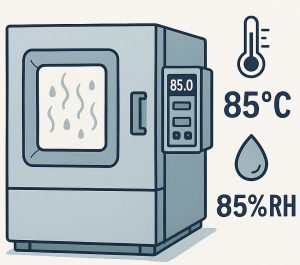
 The 85°C/85% RH test is a standardised environmental reliability test in which a product or material is exposed to a constant temperature of 85°C and a relative humidity of 85% for an extended period, typically up to 1,000 hours. This test is designed to simulate harsh, real-world environmental conditions and is widely used to assess the durability, reliability, and expected operational life of products, especially those intended for long-term use in challenging climates. It is seen as a standard for qualifying products that must survive in hot, humid, or tropical environments.
- Accelerated life testing (ALT): The 85/85 test accelerates the effects of heat and moisture, which are primary drivers of corrosion, material degradation, and failure in electronic and other sensitive components. By subjecting products to these extreme conditions, manufacturers can quickly identify potential failure modes that could occur over years of normal use.
- Reliability assurance: It is commonly used in the electronics, semiconductor, automotive, aerospace, LED/lighting, photovoltaic, and consumer electronics industries to ensure that products can withstand prolonged exposure to high temperature and humidity without significant degradation in performance or safety.
- Material evaluation: The test is useful for evaluating the resistance of materials (such as our adhesives, encapsulants and coatings) to moisture-induced swelling, corrosion, delamination, and other failure mechanisms.
How the Test Works
- Samples are placed in a controlled chamber set to 85°C and 85% relative humidity.
- The exposure period typically ranges from 100 to 1,000 hours, depending on industry standards and the intended application.
- In some cases, an electrical bias is applied during the test (Temperature Humidity Bias, or THB), which accelerates electro-corrosion and simulates real-world operating conditions.
- After testing, samples are inspected for electrical, mechanical, and visual changes, such as shifts in sensor accuracy, corrosion, or physical degradation.
The 85/85 test is defined in several standards, including JEDEC JESD22-A101, MIL-STD-202 Method 103, MIL-STD-883 Method 1004.7, IPC-TM-650 Method 2.6.11, IPC-CC-830, UL 746C, and GR-468-CORE.
The 85°C/85% RH test is a tough regime for adhesive bonded parts to pass. Moisture and high temperature are an adhesive’s sworn enemies. And both together – double whammy! Moisture ingress can lead to reduced adhesive strength and modulus of the adhesive. Water can potentially corroding the interface between adhesive and substrate, which reduces joint strength. High temperature can reduce bond strength and accelerate degradation.
It is not easy to say if any adhesive, encapsulant or coating will pass 85/85, because… well, it depends. The bond design (geometry and size and shape) matters. So does the type of substrate or substrates. So do many other factors, because your application is unique, and simple statements rarely match complex reality. But we can recommend adhesive formulations specifically engineered for high humidity and temperature resistance which are likely to perform well in your project under challenging climates and conditions… and pass the test.