Medical device designs increasingly rely on polymers like nylons, PEBAs and COC/COP cyclic olefin polymers. These plastics can give you strength, flexibility, chemical resistance and clarity. They also have very low surface energies, which means adhesives tend to bead up rather than wet. If you have ever tried to bond a glossy nylon tube, you will know the frustration.
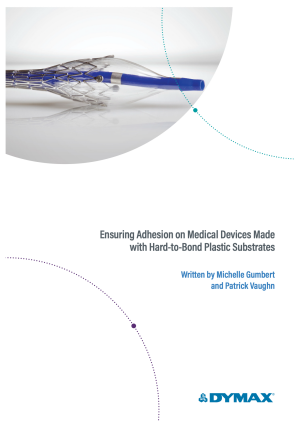 This white paper from Dymax, entitled Ensuring Adhesion on Medical Devices Made with Hard to Bond Plastic Substrates by Michelle Gumbert and Patrick Vaughn, is a useful guide for anyone assembling catheters, connectors, syringe components or wearable parts made from these plastics. It explains why bonding problems happen and what you can do early in the design phase to avoid rework, ageing failures or surprises after sterilisation.
Where problems start
Low surface energy is the big one. If the adhesive cannot wet the substrate, your joint is relying on luck. Add to that the migration of plasticisers, stabilisers or mold release agents and you have a surface that can change over time. Sterilisation cycles such as EtO, gamma or E beam can accelerate those effects. You may build a device that looks fine today but fails after validation.
What makes bonding reliable
Surface preparation consistently makes the biggest difference. Cleaning can help, but plasma surface treatment often delivers the surface activation needed for strong, durable bonds. Light curable adhesives add further control: on demand cure, rapid cycle times, and fluorescing or colour change options for inspection. Joint design matters, too. Any design that introduces peel or cleavage forces tends to show weakness under load.
Why this white paper is worth your time
If you are working with hard to bond plastics, this resource will save you trial and error. It connects the chemistry to practical production concerns like ageing, sterilisation, process validation and automated inspection. Our view is that early understanding of surface behaviour makes the whole development cycle smoother and more predictable – you should also read our technical piece Why Surface Measurement Matters in Medical Device Manufacturing on the Dyne Testing website (Dyne Testing is an Intertronics brand, and it’s where we focus on surface testing and measurement equipment).
Let’s start by talking about your application.