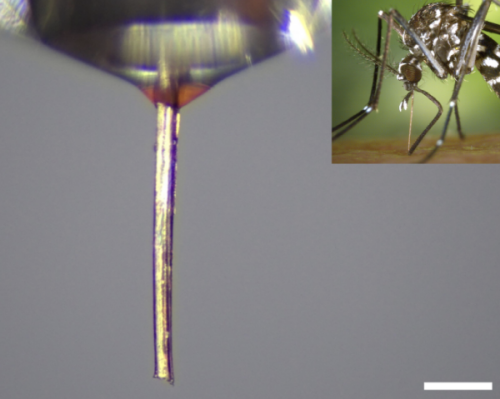
A story broke last week about engineers using a mosquito proboscis as a 3D printing nozzle. The female mosquito’s feeding tube is only about 20 µm in diameter, and the team at McGill University showed it can extrude very fine bio-inks with surprising accuracy. It highlights a simple truth in dispensing: the tool that delivers the material is just as important as the material you are working with.
Our most popular size of dispensing needle is 20 gauge – it’s the pink one with an ID of 0.6mm, about 30 times bigger than a mosquito proboscis. Most of you will never need to work at 20 µm. For almost all real-world dispensing tasks in electronics, medical devices, aerospace, automotive or any other technology manufacturing, even 60 µm is extremely fine. Nevertheless, we can get down to this level. The smallest size in the Preci-Tip™ Precision Dispensing Tips range (IDMSPREC0-M050-NS) has an internal diameter of 0.057 mm. Preci-Tips are built with consistent geometry, tight manufacturing tolerances and smooth internal surfaces that support stable, predictable dispensing across a wide range of fluids.
If your work involves small volumes, tight tolerances or assemblies where excess material causes rejects, choosing the right tip is not an afterthought. It is a core part of process control. The mosquito story simply gives us a vivid example of the same principle.
And the best part about our dispensing tip range? No mosquitos are harmed in their manufacture.
If you want help matching tip size for your project, let’s start by talking about your application.