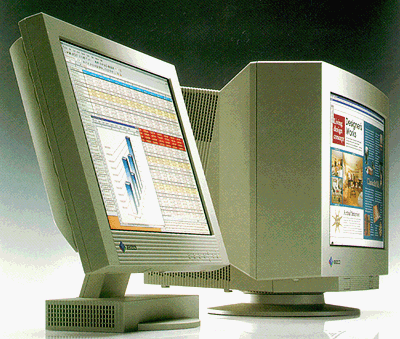
Sometime in the late 1990’s, at a trade exhibition, we decided to display our products by showing a rolling PowerPoint presentation. We used one of the very first flat screen computer monitors. This was new to almost everybody. It wasn’t very large, about 15 inches I guess, and not black and sleek like they are these days. We had it at the front of our stand, and we thought this would be a great way to encourage people to come and look at a what great stuff we had to sell them.
Nearly everybody who walked by wanted to see what was going on because they’d not seen a flat screen monitor in real life before. Many of them peered around the back to see where the cathode ray tube had got to, like small children and pets who look behind a mirror trying to find their reflection.
Sadly, not many looked at the PowerPoint presentation on which we had spent hours crafting to highlight our superior and desirable products. A few did ask how much the monitor was.
This was a confusion between what we sell, and the way in which we sell them.
The real, long-term value that we offer you is the productivity, improved quality, higher output, lower costs, reliability… and all the other benefits which accrue to your production over time as you use the materials and equipment we supply you.
We do this by means of a consultative process. We start by questioning to understand what you want to achieve – and what success looks like for you. Then we suggest products for you to evaluate and specify. The expertise and experience we bring to this process is the way in which we sell. It’s not what we sell.
And this is where our value proposition really lives.
We are not a catalogue business. We are not a “here’s a product, good luck” supplier. What we actually sell is the outcome you are trying to achieve in your process, and the confidence that it will keep working tomorrow, next month, and next year.
That means starting with consultation centred on your specific goals. We ask the awkward questions early, because understanding what success looks like for you is more important than pushing a particular material or piece of equipment. Only then do we recommend thing for you to try, based on what best fits your process, not what best fits a margin spreadsheet. That is why many customers treat us as trusted advisors, not just vendors – and why being your results focussed trusted advisor is one of our main aspirations.
It also means making it easy to do business with us. Availability, responsiveness, strong inventory, next day delivery, and proper supply chain support are not “extras”. They are part of the value. A technically perfect solution that is late, unreliable, or hard to deal with still damages productivity.
We deliberately offer an extensive but coherent range. Matched adhesive and protective materials, equipment, and consumables that work together. One supplier who understands the whole process, not five who each understand a fragment of it. That saves time, reduces risk, and removes friction from engineering teams who already have enough to think about.
And it does not stop at the point of sale. Training, process development, installation, servicing, and ongoing technical support are how value compounds over time. The product might be the visible part, but the follow through is what protects yield, quality, and uptime long after the first invoice is paid.
That old flat screen monitor was a good lesson. People were fascinated by the object, not the outcome. But we have to be clear about what we actually sell.
We sell better processes, lower risk, and predictable results. The products and the process are simply the means.
