 A peristaltic pump uses a turning rotor to squeeze plastic tubing and push fluid along inside the tubing. It is one of the simplest pumps you can buy, finding use in many places including hospitals inside kidney dialysis machines, in advanced manufacturing setups to precisely dispense adhesives, and in mines and quarries where large industrial peristaltic pumps can be used to move thick, grit-filled sludges.
How does a peristaltic pump work?
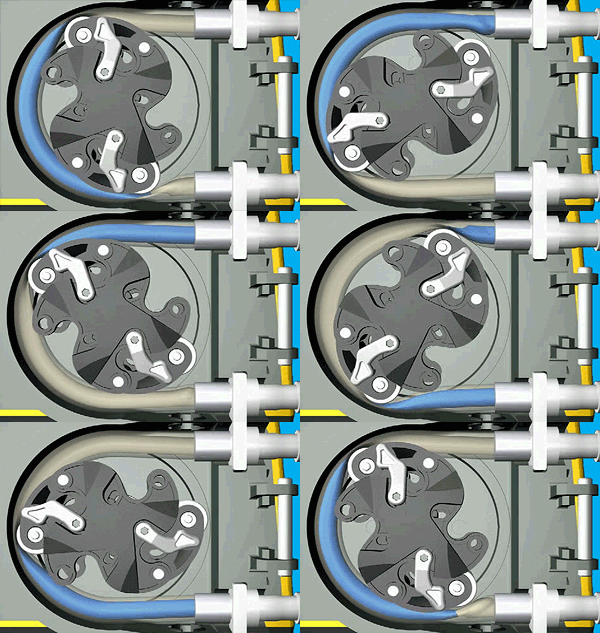
There are two main parts to a peristaltic pump:
- A turning rotor fitted with two or more rollers
- A length of flexible, elastomeric tubing.
Elastomeric tubing is made from any polymer with rubber-like elasticity that allows it to stretch significantly and then snap back to its original shape without sustaining permanent damage.
As the pump rotor turns, each roller squeezes against the tubing, closing it off and pushing fluid ahead of it. Behind the roller, the tubing springs back to its natural shape, drawing in more fluid. As there are two or more rollers on the turning rotor, a length of tubing with a fixed volume is filled with fluid, and then this volume is ejected.
The continuous motion of opening and closing the tubing ensures a steady, continuous stream of known fluid volumes and controlled flow moving from inlet to outlet.
What are the benefits of using a peristaltic pump?
Peristaltic pumps give you viscosity independent, clog-free, positive displacement volumetric dispensing or transfer of fluids.
Because the fluid passing through the pump is completely contained inside the tubing, you eliminate the risk of cross-contamination – the pump can’t contaminate the fluid, nor can the fluid contaminate the pump.
Other benefits include:
- Gentle pumping: The rhythmic squeezing action creates very little shear, making it ideal for fragile biological fluids or delicate chemicals.
- Precise dosing: Because the volume between each rotor roller is a known quantity, flow rates are highly predictable and accurate.
- Moisture and light protection: Chemically aggressive or reactive fluids are kept completely isolated from the surrounding environment inside an appropriately chosen tubing material.
- Seamless swaps: Changing fluids is as simple as replacing the disposable tubing, eliminating hours of solvent flushing.
- Reversible: Peristaltic pumps are reversible and can be used to empty lines or clear blockages, as well as prevent run-on.
- Low maintenance: There are no valves, seals, or pistons to clog, seize, or clean. The only wearing part is the tubing.
How important is the tubing?
Peristaltic pump tubing is one of the most important components of the pump and it is specially designed to withstand the continuous mechanical stress of compression and expansion as the pump rotor turns.
The inner diameter of the tubing determines the amount of fluid pumped per revolution of the rotor, while the wall thickness of the tubing is chosen to ensure it returns to its original shape after each squeeze.
As the pump relies on the inner diameter of the tubing being completely closed shut, then the tubing must be correctly sized for a specific peristaltic pump otherwise fluid motion will not occur.
As peristaltic pump tubing is a consumable whose lifespan depends on the rotor speed, operating duration, and chemical compatibility, most modern peristaltic pumps allow for rapid, tool-free tube replacement to minimise downtime.
Controlling the flow: dots and beads
Flow rate in a peristaltic pump is directly proportional to the turning speed of the rotor and the internal diameter of the tubing. Through simple programming and precise motor control, two distinct dispensing profiles can be achieved:
- Continuous beads (speed control): The peristaltic pump motor runs at a constant speed. Flow rate is smooth, predictable, and easily synchronised with automated gantry dispensing robots.
- Dots (step control): Using precise fractions of a complete rotor turn, a peristaltic pump can deliver highly repeatable, discrete volumetric dots without needing a separate shut-off valve.
The flow of a peristaltic pump is sometimes said to pulse due to the partial interruption of the flow as the rotor roller moves away from the pump outlet. During this part of the rotation, the tubing is filling as it opens rather than producing flow at the output. The level of pulsing can be controlled by adjusting the number of rollers on the rotor in the pump design, or using a smaller internal diameter in the tubing.
What are some uses for peristaltic pumps in manufacturing?
- Advanced manufacturing: Automated adhesive dispensing onto complex component geometries.
- Pharmaceutical: Precise dosing or dispensing of liquid medicines under completely sterile conditions.
- Biotechnology: Feeding bioreactors. The gentle squeezing motion doesn’t rupture delicate living cells.
- Food and drink: Pumping shear-sensitive or particulate-heavy fluids like creams, or thick sauces containing fruit chunks or seeds without crushing them.
- Printing and packaging: Flowing low-viscosity inks and coatings to printing presses.
At Intertronics, we supply the Fisnar PPD-230 Peristaltic Pump Dispenser for adhesives, solvents, and low viscosity liquids that can be integrated into automated dispensing systems. Contact us to find out more and let’s start by talking about your application.
