 What do we call visible light? We call it color. But the electromagnetic spectrum runs to zero in one direction and infinity in the other, so really, children, mathematically, all of light is invisible.
This is a quote from the masterful and luminous novel All the Light We Cannot See by Anthony Doerr, which won the Pulitzer Prize for Fiction in 2015. Behind the mathematics and physics is a thought provoking observation about light and the limits of human perception. I am going to hijack it for this discussion about the UV light spectrum.
We are used to thinking about visible light as a spectrum. Red light is different from blue light; we see the difference immediately and call it colour. Once we move beyond the wavelengths our eyes can detect, that intuitive distinction disappears. And UV (ultraviolet) light is indeed invisible – mathematically and by definition. It’s not visible, so UV light is part of all the light we cannot see. Because UV light is invisible to us, it is easy to think of “UV” as though it were one thing. It isn’t.
A spectrum, rather than a wavelength
When we describe a UV curing lamp as broad spectrum, we’re describing the range of wavelengths of light it produces. Traditional mercury arc UV curing lamps emit light over a relatively wide range of wavelengths. A metal halide mercury arc lamp, for example, can produce UV-C, UV-B and UV-A radiation, as well as some visible light.
Its output isn’t evenly distributed across that range. Instead, there are numerous peaks at different wavelengths. The spectral output graph in our white paper Moving to UV LED Curing, the 365nm Myth is a good illustration: there is useful radiant energy spread across a substantial part of the UV spectrum and extending into the visible. Collectively, that’s what we mean by broad spectrum.
By comparison, the output of a UV LED curing lamp is concentrated within a much narrower range. A UV LED lamp is usually identified by its nominal wavelength, such as 385 nm, 395 nm or 405 nm, although its actual output occupies a band around that nominal value rather than being a single monolithic wavelength.
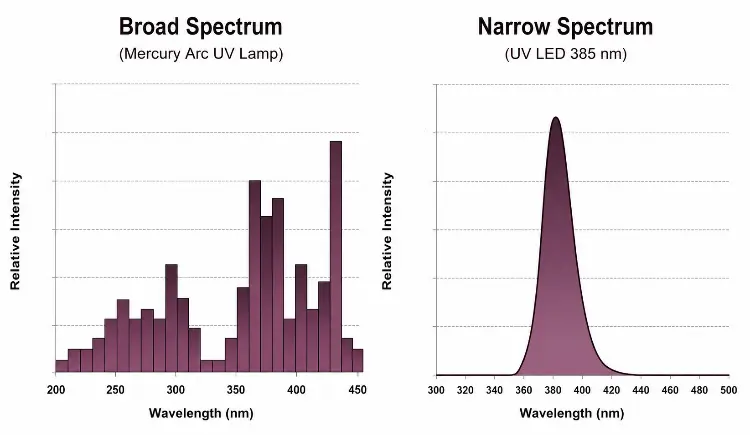
Chart showing examples of the different kinds of spectral output of a broad spectrum mercury arc lamp and a UV LED lamp
So “broad spectrum” and “narrow spectrum” describe the distribution of wavelengths, rather than the amount of UV being produced. We use the term “broad spectrum” as a shorthand to describe a traditional mercury arc UV curing lamp. In contrast, we don’t tend to use the term “narrow spectrum” very much to describe a UV curing lamp based on LED (light emitting diode) technology – UV LED seems to be enough.
The important point is that the light source must suit the chemistry, not the other way around. UV curable adhesives, coatings and inks contain photoinitiators which absorb particular ranges of wavelengths, and it is this interaction that initiates the cure. We cannot assume that any source labelled “UV” will do the same job. Successful UV curing depends on matching the spectral output of the lamp with the absorption characteristics of the photoinitiator system in the material. In other words, we should choose the lamp for the material we need to cure, rather than expect the chemistry to accommodate whatever lamp happens to be available.
Why do we still use broad spectrum UV lamps?
With all the advantages of UV LED technology, why would we still specify a broad spectrum lamp? There are two important reasons.
- Many established UV curable materials were formulated and validated using broad spectrum mercury lamps, and their photoinitiator systems may make use of energy from several parts of that spectrum. Moving to a LED UV source can change the cure and potentially the resulting material properties.
- Different wavelengths can contribute to different aspects of the cure. Longer wavelengths penetrate more deeply into the material, while shorter wave UV light is particularly useful at exposed surfaces, where it helps overcome oxygen inhibition and achieve a tack-free surface cure. A broad spectrum source can therefore provide both depth of cure and surface cure from the same lamp.
Broad spectrum does not mean high intensity
A broad spectrum lamp isn’t necessarily more powerful than a UV LED lamp. In fact, a UV LED curing lamp may deliver very high intensity within its relatively narrow wavelength band. Spectrum and intensity describe different characteristics of the light. Spectrum tells us which wavelengths are present; intensity, usually expressed in mW/cm² or W/cm², tells us how much radiant power is arriving at a given area.
We started with an observation about how human perception shapes the way we think about light. Visible light seems special to us because we can see it; within it, different wavelengths announce themselves as different colours. Move beyond the limits of our vision and that intuitive understanding disappears – UV light becomes simply “UV”. But the chemistry doesn’t share our limitations. A photoinitiator can distinguish between wavelengths our eyes cannot, responding strongly to some and hardly at all to others. What is invisible and apparently indistinguishable to us is anything but indistinguishable to the material we are trying to cure.
Perhaps that’s the most useful way to think about the UV spectrum: not in terms of what we can see, but what the chemistry can see.
