Browse industry-specific solutions for bonding, coating, and dispensing. Find proven materials and manufacturing technology tailored to your exact requirements.
Many product data sheets for UV light curing adhesives and materials suggest that they need to be cured with 365nm UV light, or they show an example cure time with an intensity measured at 365nm. The implication is that these adhesives require a 365nm LED light to cure. This paper explains how a dance between physics and chemistry belies the myth that 365nm is always needed.
First, some chemistry
Ultraviolet-cured adhesives became available in the early 1960s but developed rapidly with advances in chemical and equipment technology during the 1980s. The large majority are cured by the free radical polymerisation of acrylate functional resins. Some chemistries (i.e. epoxy) are cured by a cationic reaction; this discussion still applies.
UV light curing adhesives are made up of monomers, oligomers, thickeners, adhesion promoters, and various other additives… and a relatively small proportion of photoinitiators (PIs). When the right light hits the PIs, they split and form highly excited free radicals, which initiate and accelerate the curing/crosslinking process. Supplying this appropriate light energy is key to a fast and complete curing reaction.
Long wave UV
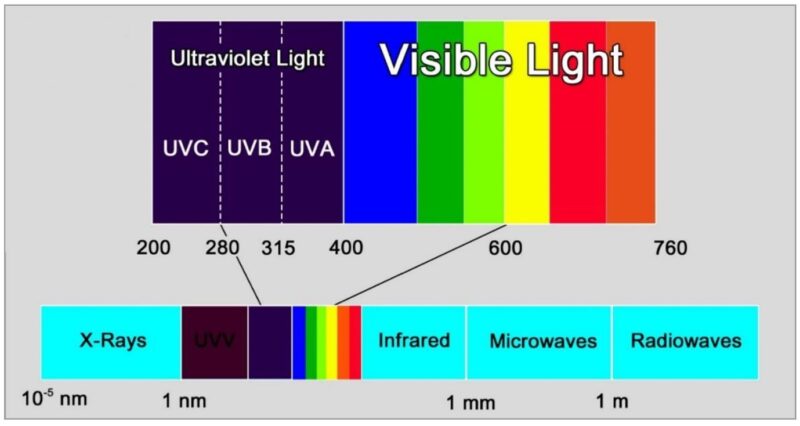
For adhesives and most thick layer (> 50 microns) materials, long wave UV-A (315-400nm1) is required, because it has the ability to penetrate and give depth of cure. Short wave UV-C (100-280nm1) is confined to curing thin films like inks because its ability to penetrate is very low – UV-C is almost never observed in nature because it is completely absorbed by the atmosphere.
Figure 1 – The electromagnetic spectrum
Physics to the rescue
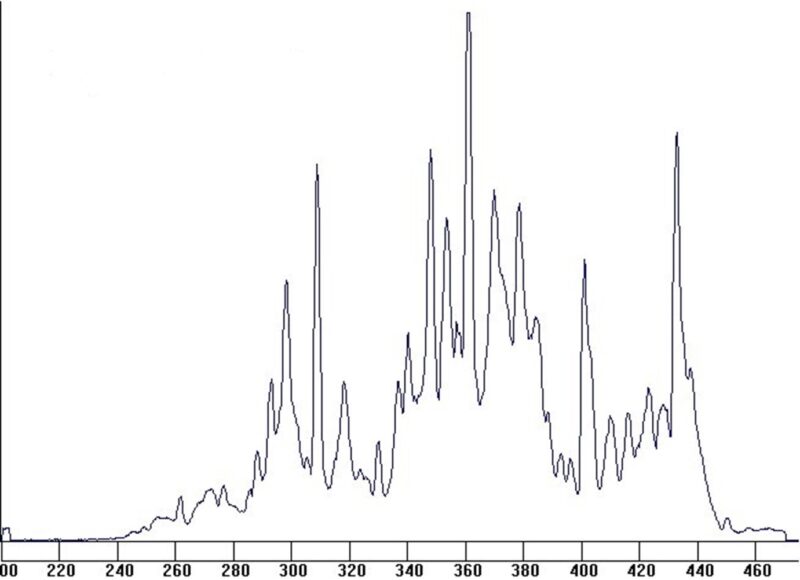
Manufacturers of UV curing adhesives needed sources of UV-A light which were readily available and had practical functionality. From the mid-1800’s, scientists have known about the UV output of mercury vapour arc lamps, and from the 1930’s they were readily available for industrial purposes. Medium pressure mercury arc lamps, doped with a metal halide, generate appreciable amounts of UV-A light – see Figure 2.
Figure 2 – Spectral output of a metal halide mercury arc lamp
We call this a broad spectrum output, with light from UV-C right up to the visible range. You will notice that the bulk of the energy is in the UV-A range, with lesser amounts of UV-C, UV-B and visible light. There is a peak at 365nm, in the middle of the UV-A range; that’s physics. 365nm is the strongest but not the only light energy.
Back to chemistry and PIs
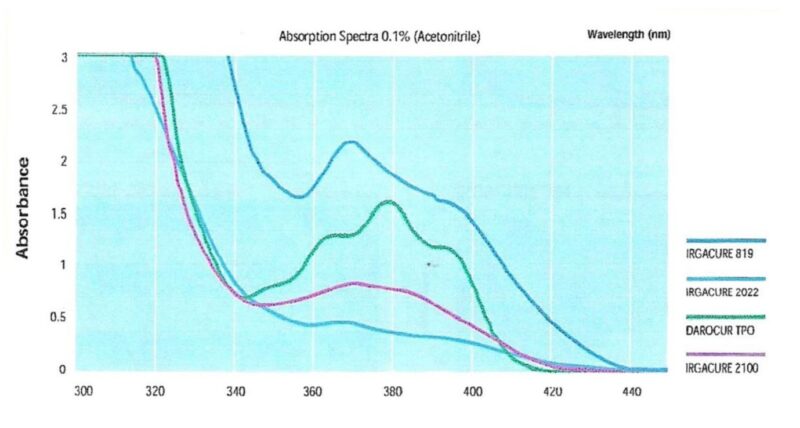
The photoinitiators need to absorb the light energy in order to react. Suppliers of photoinitiators provide some information about the wavelengths their PIs absorb.
Figure 3 – Absorption spectra of some Ciba photoinitiators (0.1 wt % in acetonitrile solvent)²
You can see from Figure 3 that the PIs do not absorb light energy only at 365nm, but across a wide range of the spectrum.
The situation is further complicated because UV curing adhesive formulators might use more than one PI in their recipes. For example, in order to optimise the cure when bonding plastics, PIs with more of an absorption in the visible light range are added with the UV light ones. Plastics often contain UV blocking agents to inhibit light aging, so a wider range of PI light absorption is beneficial to take advantage of whatever light gets through the substrate.
So, adhesives which are designed to cure with broad spectrum mercury arc UV lamps react with a wide range of light, and use the energy from across the spectrum to cure optimally. Much of the useful energy is in the UV-A range, which is where the bulk of the UV lamp output is, centred around 365nm, but not exclusively so. In fact, the short wave UV light element of the output is useful in overcoming any oxygen inhibition.2
Back to physics with light emitting diodes (LEDs)
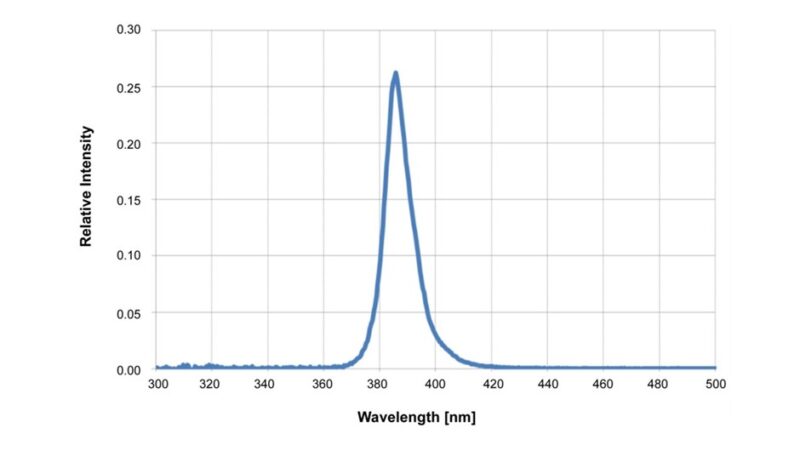
LEDs which emit UV light have been developing at a rapid pace in recent years, and they are readily available in the form of UV curing lamps. Their output intensity (up to 40 W/cm2) are the match for any mercury vapour lamp. However, their output in terms of wavelength is very different – see Figure 4.
Figure 4 – Spectral output from a 385nm LED UV curing lamp
The UV generated by the LED lamp is very narrow spectrum, not broad spectrum like before. We don’t have any short wave UV, or visible light either. So an adhesive formulated to cure with broad spectrum UV light may very well react differently to narrow spectrum UV LED light, and this is something to watch out for.
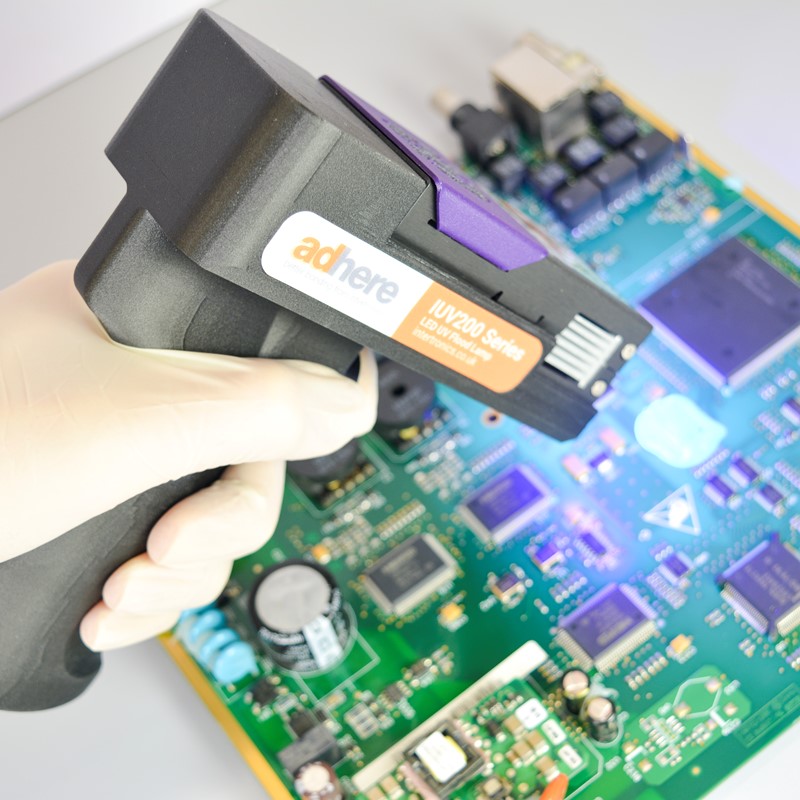
The good news is that we can select the wavelength output for the UV LED curing lamp – 365nm, 385nm, 395nm and 405nm are all common. So, shouldn’t we choose 365nm for our UV LED curing, to correspond with the peak output from our mercury arc lamp?
Well, not necessarily, and indeed, probably not – for two reasons.
Chemistry, again
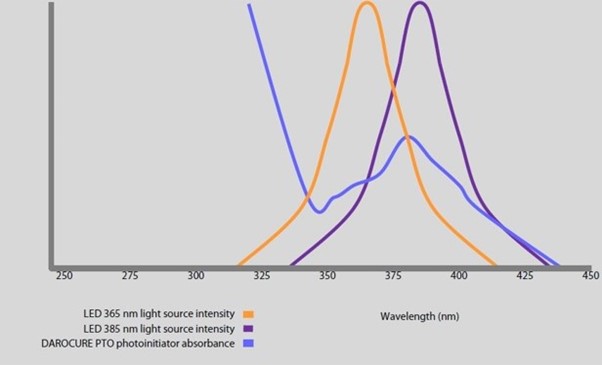
Figure 5 shows the absorbance of a typical PI used in the formulation of UV curing adhesives. In this example, you will notice that while the 365nm light interfaces well with the PI, the 385nm light will be absorbed very readily by the PI, and across a wider range.
Figure 5 – Photoinitiator absorption compared to 365nm and 385nm UV LED curing lamp spectral distributions
Physics and money
The development of UV LEDs continues apace, but there is a fundamental characteristic which remains – as you go shorter in wavelength, the LEDs are less strong in their output, and they cost more money. Commercially available UV-C LED output is measured in single digit mW/cm2 at the time of writing, compared to the 40 W/cm2 we mentioned earlier for long wave systems. These differences will narrow as time goes on and LED scientists become more successful, but they may be significant today.
365nm and compromise
Making the switch to LED UV curing from broad spectrum mercury arc UV lamps is an attractive proposition5. You may even be tempted to buy some 365nm LED modules when setting up your curing process, if the datasheet mentions that ubiquitous 365nm number. But there are very good reasons to consider a longer wavelength UV LED lamp:
You are likely to get a better bang for your buck. 385nm, 395nm or 405nm UV LED lamps can generate more intensity for less money. Higher intensity will mean faster cure and possibly more complete crosslinking. We recommend a minimum of 50mW/cm2 of incident UV curing light.
You are likely to get better depth of cure with longer wavelengths, because they are not absorbed as easily and penetrate better.
You are likely to get as good or better cure with longer wavelengths, because PIs are not single wavelength specific.
All this comes with one, very large, proviso. UV curing adhesives designed to be cured with broad spectrum UV light are going to behave differently when cured with a narrow spectrum UV source. Unless specifically stated on the product data sheet as “LED curable” or similar, assume that the adhesive is designed to be cured with broad spectrum UV light. Even if a full cure is accomplished with a UV LED lamp, the final physical characteristics may be different than expected. It is highly recommended that the curing process is fully evaluated to ensure that the final result meets your requirements. A good adhesive supplier will have experience of using different kinds of lamps to cure their products, and their advice can be time-saving and invaluable.
And finally, chemistry wins
Leading UV adhesive manufacturers are formulating for LED UV curing, and will have adhesives which are made to be optimally cured with LED technology. For example, Dymax MD® 1405M-T-UR-SC needle bonding adhesive is optimised to be LED curable at 405nm wavelength light. If you are looking at a new bonding project today, the best course is to evaluate an adhesive which is designed to be cured with LED UV technology. Find a supplier who will be able to offer matched materials and equipment.
References
“Wavelength ranges are defined in ISO 21348” – Definitions of Solar Irradiance Spectral Categories
“Photoinitiators” – Igor Khudyakov, PhD, DSc, Dymax Corp, 2018
“UV Curing and Tack-Free Cures” – Intertronics Technical Bulletin, 2019
“LED Curing of Light-Curable Materials, Unravelling the Myths and Realities” – Gary Zubricky & Kirk Middlemass, Dymax Corp, 2010
“Ensuring Success When Switching from Conventional Lamp to LED Light Curing Sources” – Dymax Corp white paper, 2020