How to identify a mixing nozzle

What mixing nozzle have I got?

A static mixing nozzle is a vital dispensing consumable, used for the successful mixing or blending of two-part adhesives, potting compounds, and other protective materials, where products are packaged in cartridges or used in metering and mixing equipment. But how do you identify which one you have so that you can order more?

There are a number of design features and characteristics that make up a static mixer:

  • Element shape and style
  • Mix ratio
  • Inner diameter
  • Number of elements
  • Connection interface
  • Nozzle termination

Elements and ratios

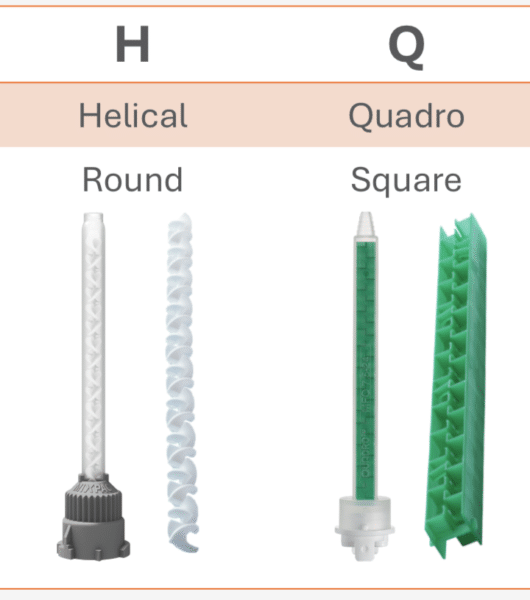
The first, and perhaps most obvious, is the shape of the element section. Static mixers are typically either round, known as ‘helical’, or square, known as ‘Quadro™’. A further feature of the element section is the colour – usually white, yellow, or blue if they are round, and green if they are square for 1:1 and 2:1 mix ratio. This deviates sometimes; when nozzles are designed for wider ratios such as 4:1 and 10:1, they often have elements or features that are orange in colour instead. You will have insight on the ratio from the material you are using.

Comparison images of round, helical static mixing nozzles and square, quadro static mixing nozzles from Medmix.
Static mixing nozzle designs. H, round, helical. Q, Quadro, square

ID and numbers

Once the style and ratio are determined, two further characteristics can be identified from the element section: the inner diameter and the number of elements contained. The inner diameter for round nozzles, or width for the square design, is typically rounded to the next whole number and measured in millimetres (mm). The number of elements can be determined by counting them. Elements are typically in multiples of four.

Interface

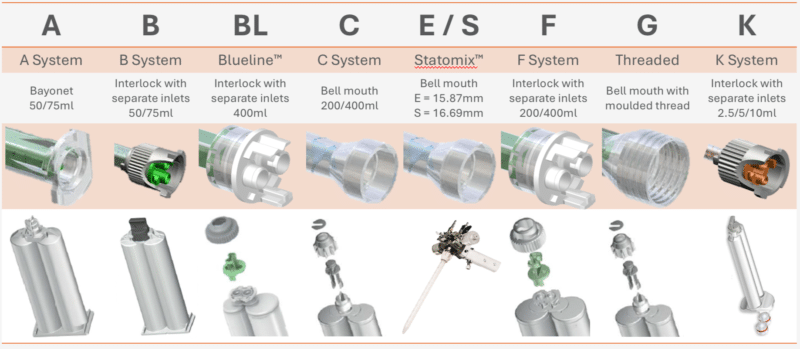
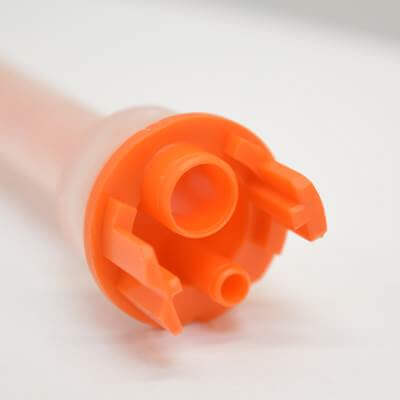
The interface between the metering and mixing equipment or cartridge and the nozzle is another distinct design feature. Medmix MIXPAC™ have a number of designs to cater for different sizes and design of cartridge and equipment. MIXPAC’s latest designs, the B System and F System, are moulded to keep 2K materials separate further into the mixer to help avoid cross-contamination. These have an interlocking mechanism, whereas the A System uses a simple bayonet and the C System uses a retaining threaded nut, emulated by the moulded-thread ‘G’ type nozzles.

Comparison table of mixing nozzle connection types with technical images and text descriptions
Comparison table of mixing nozzle connection types. A System: Bayonet 50/75 ml. B System: Interlock with separate inlets 50/75 ml. BL Blueline System: Interlock with separate inlets 400 ml. C System: Bell mouth 200/400 ml. E/S Statomix System: Bell mouth, E=15.87 mm, S = 16.69 mm. F System: Interlock with separate inlets 200/400 ml. G Threaded System: Bell mouth with moulded thread. K System: Interlock with separate inlets 2.5/5/10 ml.

Connection on the end

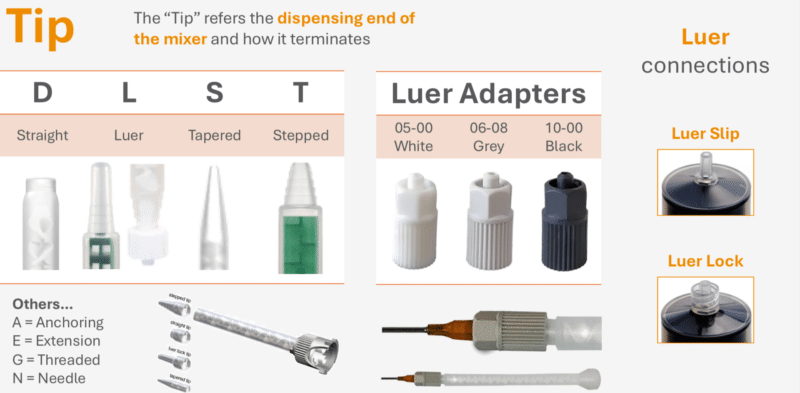
At the opposite end is where the mixing nozzle is terminated. Nozzles are available in several designs to help with high flow, attachment of a blunt Luer lock dispensing tip, or other speciality ends such as spreaders.

Comparison of the shapes of different MIXPAC mixing nozzle shapes
Mixing nozzles can have a variety of tip types to accommodate flow rates, attachments, or other requirements. The “tip” refers to the dispensing end of the mixer and how it terminates. D = Straight. L = Luer. S = Tapered. T = Stepped. A = Anchoring. E = Extension. G = Threaded. N = Needle. Luer connections can be of Luer Slip (LS) and Luer Lock (LL) type. Luer adapters are white 05-00, grey 06-08, black 10-00.

Part numbers

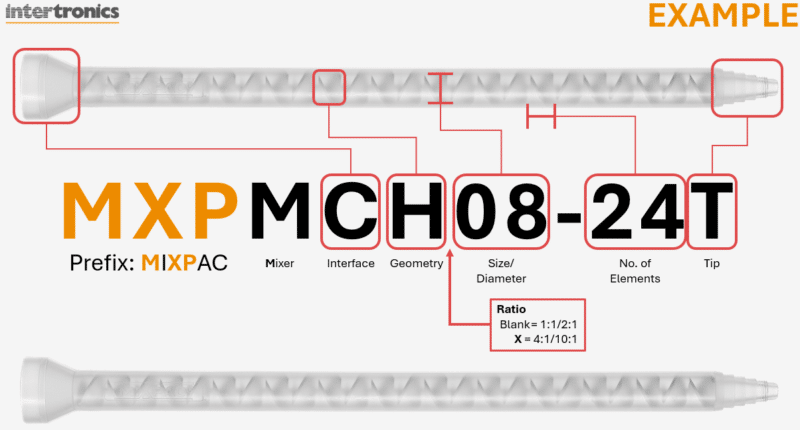
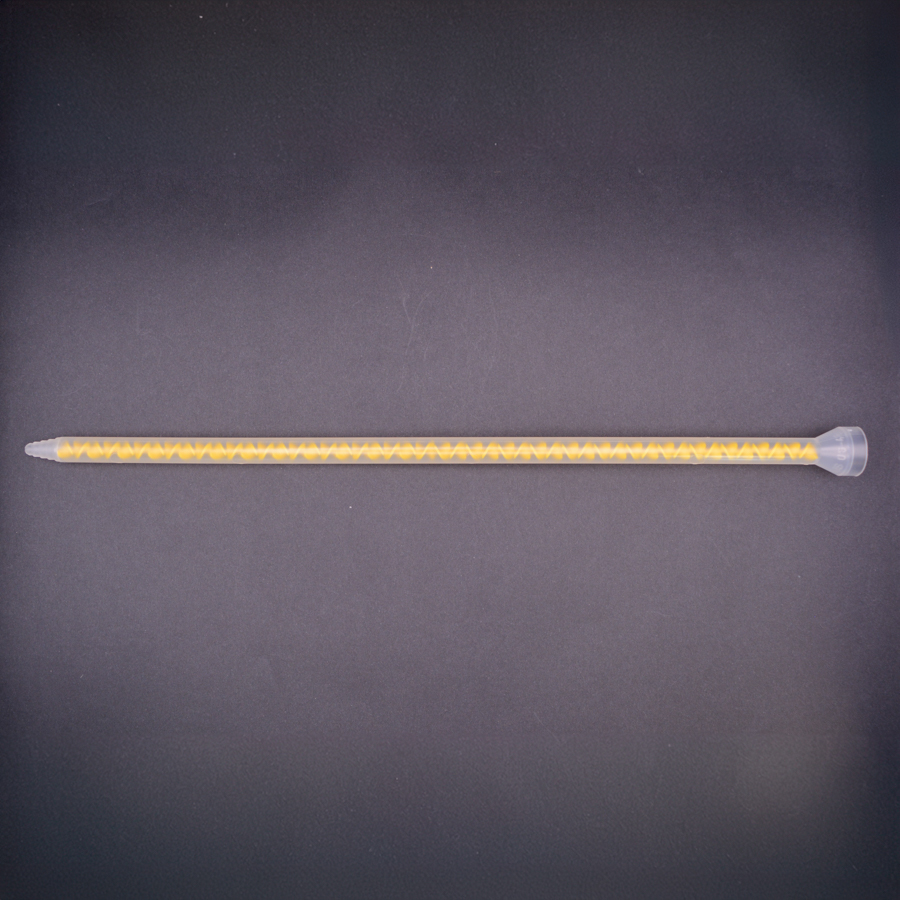
Many medmix MIXPAC mixing nozzles have their key information moulded into them, including their brand (Quadro, for example) and their diameter and number of elements (06-32, for example would mean 6mm diameter and 32 elements). These distinguishing marks, in additional to the above, will provide the Intertronics Customer Support Team with the necessary information to help identify your static mixing nozzle.

Mixing nozzle with internal mixing geometry visible through the outer wall
How part numbers for medmix MIXPAC nozzles are organised. The part number can tell you the interface, geometry, mixing ratio, size/diameter, number of elements, and tip type.

MIXPAC mixing nozzles

  • Available for next day delivery
  • Range suitable for most two-part cartridge systems and metering & mixing machines
  • Premium Swiss quality

Applications include:

  • Dispensing two-part adhesives
  • Potting compounds
  • Materials such as epoxy, polyurethane, acrylic, and MMA methacrylate

Last updated: 1 November 2024

Version: 1.0

Reference number: TB2024-02

Download

Download a printable copy of this resource.