- Products
- Industries
-
-
-
Industries
Browse industry-specific solutions for bonding, coating, and dispensing. Find proven materials and manufacturing technology tailored to your exact requirements.
-
-
-
- Knowledge centre
- News and insights
- About us
-
-
-
About Intertronics
Get a clearer view of the team, facilities and standards behind the technical support offer.
-
-
-
- Contact us
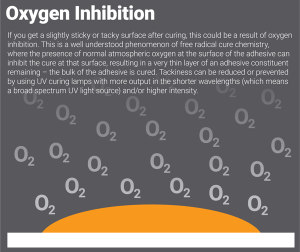
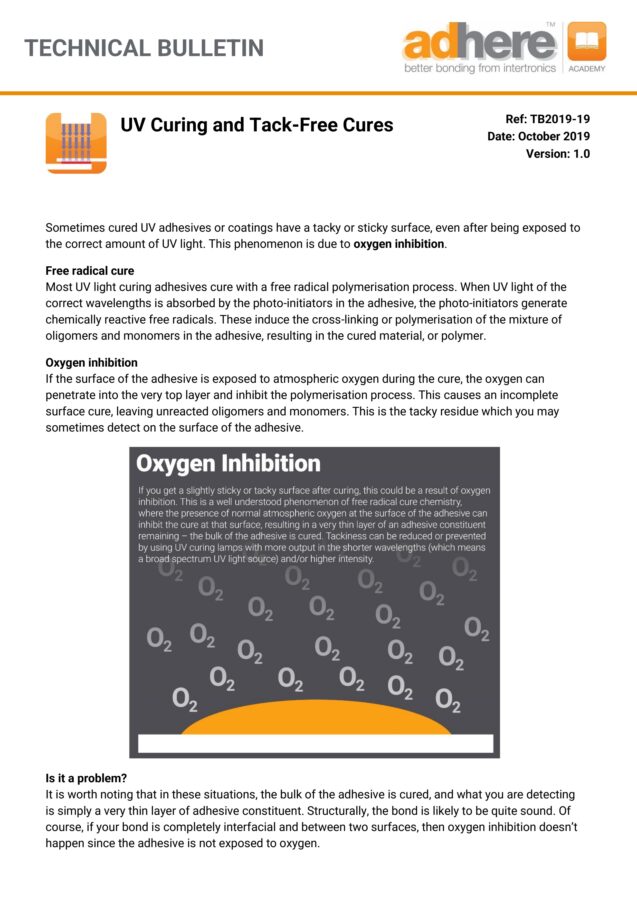
Sometimes cured UV adhesives or coatings have a tacky or sticky surface, even after being exposed to the correct amount of UV light. This phenomenon is due to oxygen inhibition.
Free radical cure
Most UV light curing adhesives cure with a free radical polymerisation process. When UV light of the correct wavelengths is absorbed by the photo-initiators in the adhesive, the photo-initiators generate chemically reactive free radicals. These induce the cross-linking or polymerisation of the mixture of oligomers and monomers in the adhesive, resulting in the cured material, or polymer.
Oxygen inhibition
If the surface of the adhesive is exposed to atmospheric oxygen during the cure, the oxygen can penetrate into the very top layer and inhibit the polymerisation process. This causes an incomplete surface cure, leaving unreacted oligomers and monomers. This is the tacky residue which you may sometimes detect on the surface of the adhesive.

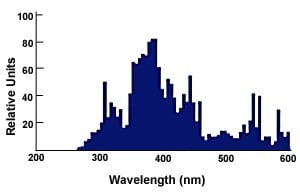
If you get a slightly sticky or tacky surface after curing, this could be a result of oxygen inhibition. This is a well understood phenomenon of free radical cure chemistry, where the presence of normal atmospheric oxygen at the surface of the adhesive can inhibit the cure at that surface, resulting in a very thin layer of an adhesive constituent remaining – the bulk of the adhesive is cured. Tackiness can be reduced or prevented by using UV curing lamps with more output in the shorter wavelengths (which means a broad spectrum UV light source) and/or higher intensity.
Is it a problem?
It is worth noting that in these situations, the bulk of the adhesive is cured, and what you are detecting is simply a very thin layer of adhesive constituent. Structurally, the bond is likely to be quite sound. Of course, if your bond is completely interfacial and between two surfaces, then oxygen inhibition doesn’t happen since the adhesive is not exposed to oxygen.
If the joint design has exposed adhesive fillets, then a sticky surface can occur. We would define this as when you feel a tack as you rub a finger across the surface, and get traces of wet residue on your gloved hand. This can be undesirable from the perspective of contamination or aesthetics.
Modern adhesive formulations are less likely to have tacky cured surfaces when cured with the correct equipment, as the chemists have become quite clever in mitigating it, but it does happen – more likely in older products or softer adhesives. Some soft adhesives can be formulated with additives that still remain sticky when fully cured; these appear to be signs of oxygen inhibition when actually these are deliberate cured properties.
So how do you overcome it?

Overcoming it: Higher intensity
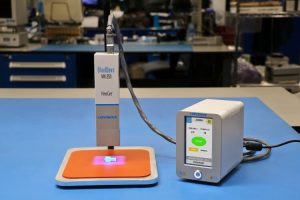
More intense UV light has the chance of completing the cure before the oxygen inhibition phenomenon takes effect. In general terms, you will get more optimal cures by using higher intensity curing lamps –cure times will be shorter too.

Overcoming it: Broad spectrum light
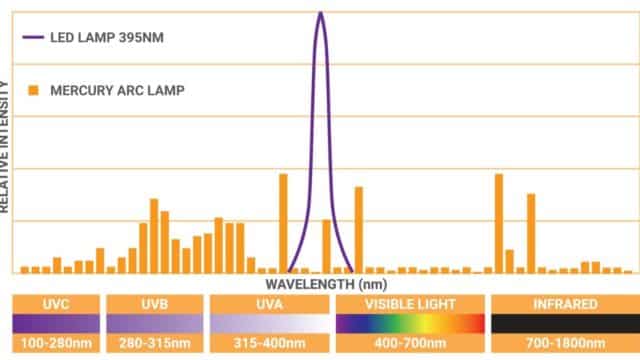
Oxygen inhibition can be prevented by short and medium wavelength UV because the higher energy causes a quicker breakdown of the photo-initiators and there is less time for oxygen to flood into the exposed adhesive surface. We need to combine the shorter wavelengths with longer wavelength UV light to help us get good depth of cure, and our metal halide UV bulbs usually generate the right balance of curing light (approximately 300-450 nm). In some cases, the use of a bulb with higher amounts of short wave UV (mercury UV bulb) will overcome oxygen inhibition.

Overcoming it: Exclude oxygen from the adhesive surface
There are a few ways to do this. You can place a thin film of plastic over the adhesive and cure through the plastic. Many adhesives will have poor adhesion to plastics like polypropylene or polyethylene, and so these films can be removed easily post cure. Alternatively, cure under an inert gas like nitrogen or argon.
Overcoming it: Remove the tacky layer
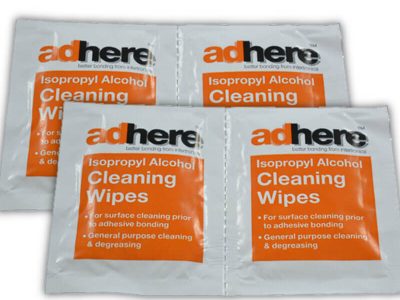
If tackiness from oxygen inhibition cannot be avoided by an improved process, the tacky layer can be readily removed with an isopropyl alcohol (IPA) wipe.

Overcoming it: Curing with LED UV lamps
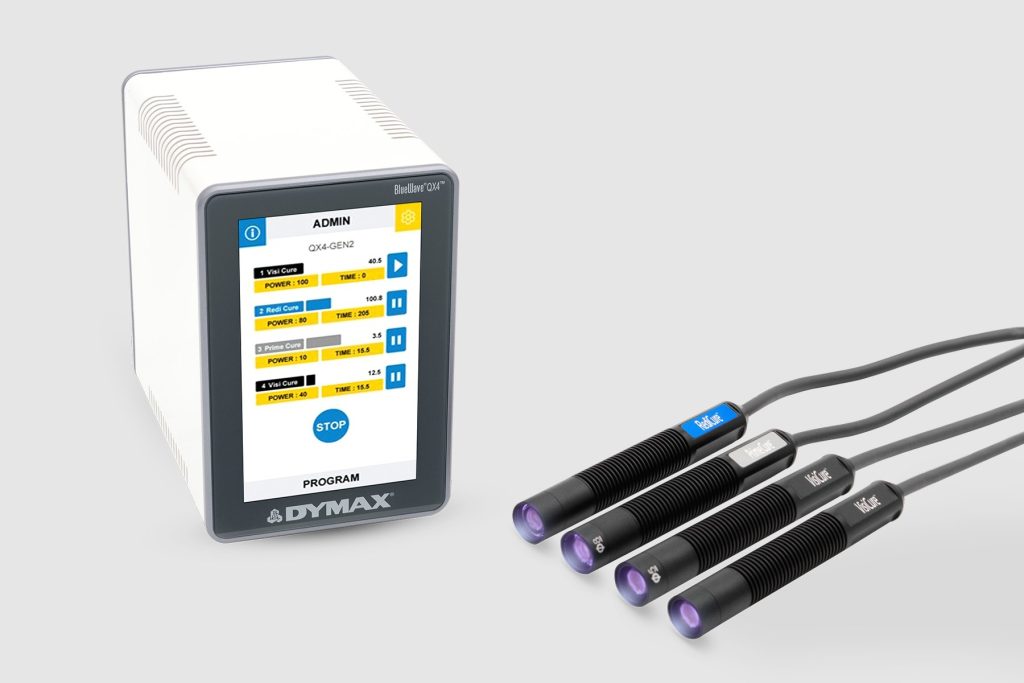
UV curing lamps made with LEDs, as opposed to mercury arc lamps, are becoming very popular because they offer many advantages. One thing to consider is their ability to cure your adhesive tack-free. Note that oxygen inhibition can be prevented by short and medium wavelength UV curing light. LED UV curing lamps emit narrow spectrum light primarily in the long wave zone, and so may struggle to achieve a tack-free cure with some adhesives which are prone to oxygen inhibition.

Recommendations
If you are experiencing sticky or tacky surfaces on your adhesive or coating, here are our recommendations:
- Use higher intensity UV light
- Check your bulb output – it may be due for replacement. Try a new bulb
- Bring the lamp closer to the adhesive surface
- Cure for a longer period
- Use a more powerful UV lamp
- Use more short wave UV light
- Try a broad spectrum UV curing lamp rather than a narrow spectrum LED UV curing lamp
- Try a bulb with a higher output of short wave UV light
- Exclude oxygen from the surface
- Change the adhesive to one which is less sensitive to oxygen inhibition
- Specify an adhesive which is formulated to cure tack-free with LED UV curing lamps, which will also allow you the numerous benefits of LED curing technology

Success
The recipe for success is to specify the optimal adhesive, and understand the curing process with wavelengths, intensity and exposure time. With the right combination, tack-free cures are achieved.