Browse industry-specific solutions for bonding, coating, and dispensing. Find proven materials and manufacturing technology tailored to your exact requirements.
Electronic textiles development benefits from UV curing resin and precise dispensing
Customer
The Advanced Textiles Research Group at Nottingham Trent University has been developing electronic textiles to add functionality to materials and garments. Recent advances have allowed for reduction in size and cost of semiconductors and microelectromechanical systems, and by incorporating these electronic components at the yarn-making stage, the Group has greatly broadened the possibilities for electronic textile applications.
Precise, volumetric dispensing of encapsulant provides accurate, repeatable results
Challenge
Some of the applications possible with this “electronic yarn” include temperature sensing, sensors for medical monitoring, motion sensing, textile energy harvesting, and illumination. As electronic components continue to diminish in size, the number of applications for electronic yarn will grow. It is anticipated that the market for electronic textiles will expand very rapidly over the next decade.
Integrating the electronic components within the yarn fibres allows the textile properties of the fabric, such as tensile recovery, drapability, and breathability to be maintained.
Part of the incorporation process involves encasing microchips within a polymer micro-pod in order to protect them from mechanical and chemical stresses during everyday use. The team at the Advanced Textiles Research Group approached Intertronics for assistance with automation of the micro-pod process.
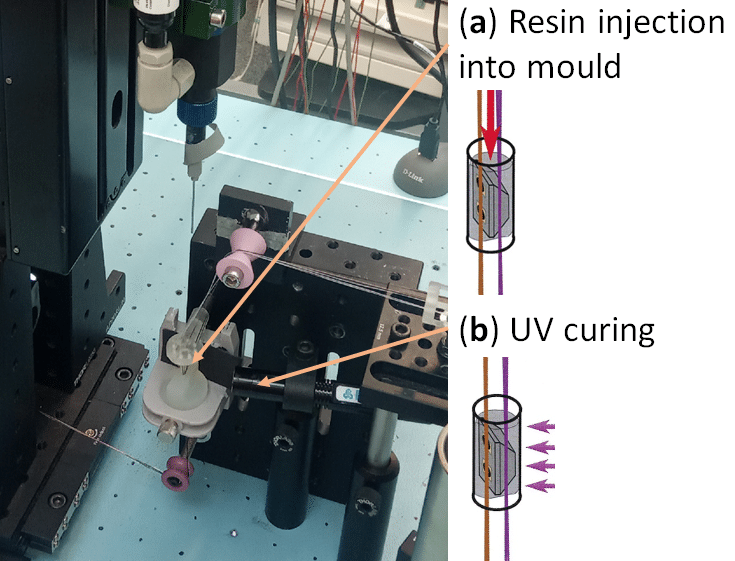
Figure. 1 The machinery used for the creation of a resin micro-pod around the package die, with diagrams showing stages in the process: (a) injection of resin into a tubular mould containing the LED; (b) UV-curing of the resin using the UV lightguide Image credit: Advanced Textiles Research Group, Nottingham Trent University. Diagram credit: Hardy, D. A. et al. (2019) “Automated insertion of package dies onto wire and into a textile yarn sheath,” Microsystem Technologies. doi: 10.1007/s00542-019-04361-y.
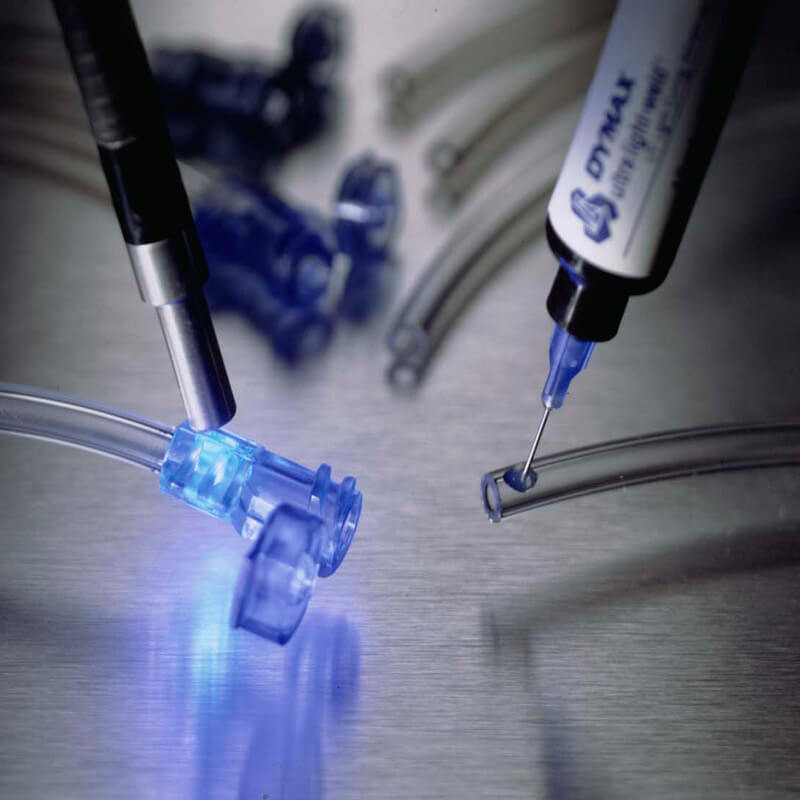
For encapsulation of the microchip, the team narrowed their resin search to UV curing resins, which were preferable to heat curing resins due to process time considerations and potential damage caused to components from heat exposure or temperature-induced deformation. Using a UV curing resin also reduced solvent emissions, which was desirable. In particular, Dymax Multi-Cure 9001-E-V3.5 was chosen as it is transparent to visible light, making it suitable for LED encapsulation, and flexible, making it suitable for textile applications.
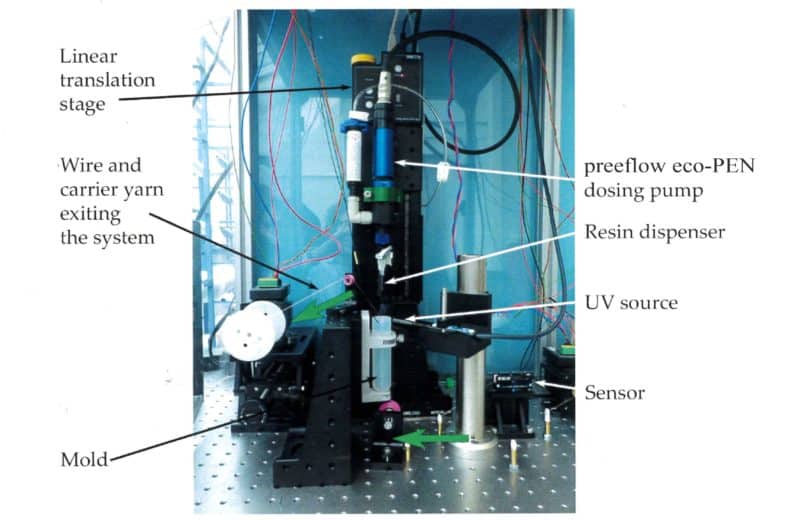
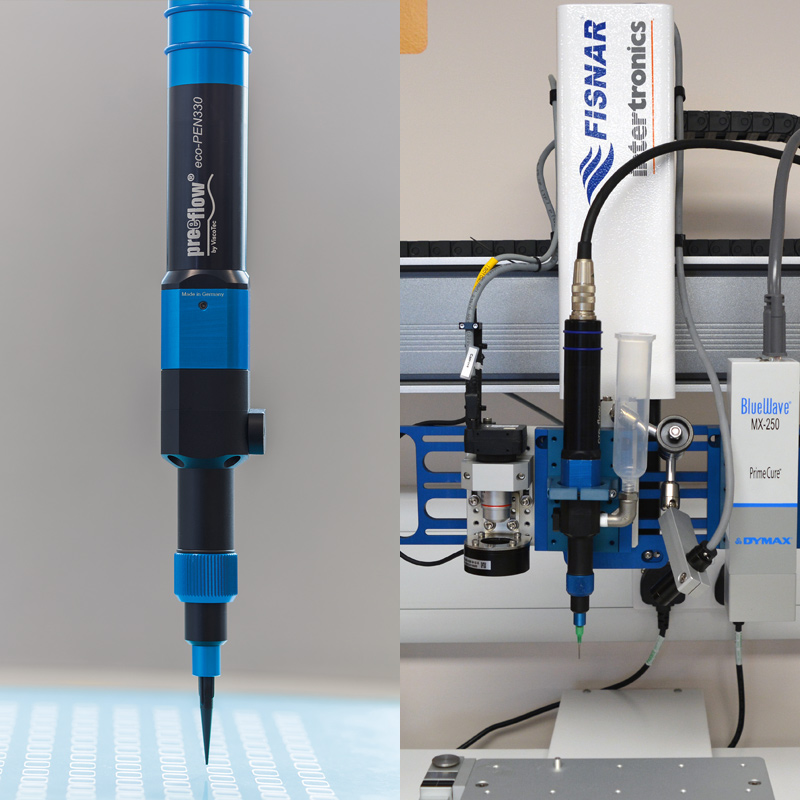
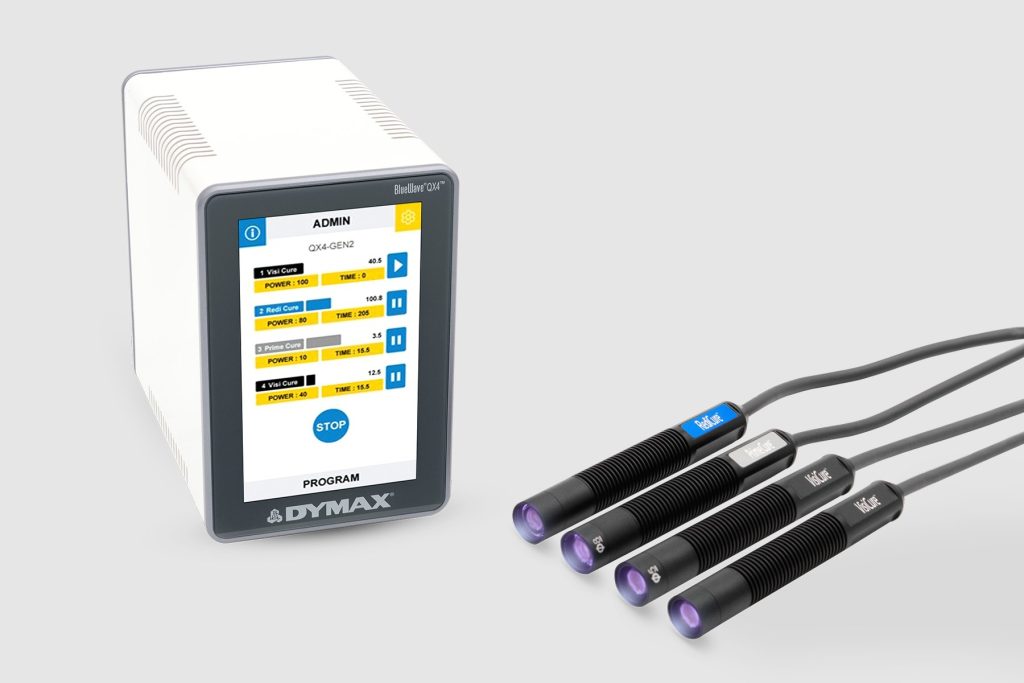
The Dymax Multi-Cure 9001-E-V3.5 resin is dispensed using a preeflow eco-PEN, which provides precise, volumetric dosing onto the microchip inside a tubular silicone mould. The resin is then rapidly cured within the mould using a Dymax BlueWave QX4 lamp.
Results
Figure 2: The encapsulation system with the main components labelled Image credit: Advanced Textiles Research Group, Nottingham Trent University.
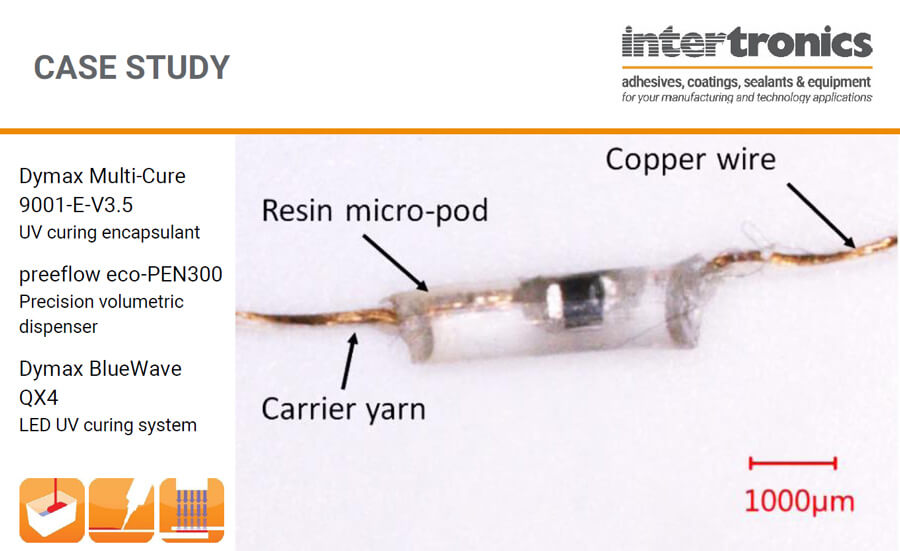
The resulting micro-pod, which measures just 1 mm in diameter (see image on previous page), is then encased within a knitted sheath and woven or knitted into textiles.
Matt Baseley, Senior Internal Technical Sales Specialist at Intertronics said:
“We visited the Advanced Textiles Research team on site to discuss challenges they were facing, and to fully understand the process they wanted to achieve. Following our discussions, we suggested a few Dymax electronics-grade UV-curing encapsulants which were flexible and
transparent. They then trialled some samples and found that Dymax Multi-Cure 9001-E-V3.5 met their needs. Next, we discussed volumetric dispensing as an alternative to time/pressure dispensing which introduced variations into their process. By dispensing volumetrically with the preeflow eco-PEN, they can have confidence that a consistent amount of encapsulant is dispensed every time.
“Once they had the material and equipment chosen, we helped them to fine-tune the micro-pod process to overcome any remaining challenges they were facing.
“This application was really interesting and we’re excited to see how the market progresses and the technology is adopted moving forward. It was a privilege to be involved from the early stages of the project.”
Dorothy Hardy, Research Fellow in Manufacturing of Functional Electronic Textiles at Nottingham Trent University, said:
“Intertronics were able to give us off-the-shelf solutions that were fine tuned to our needs. This was particularly useful in helping us to set up a completely novel type of production line as quickly as possible. Through the course of several visits, Matthew Baseley and Paul Whitehead worked with us to fine tune our process, taking the time to teach us how to use the new equipment, and suggesting improvements. They were knowledgeable and approachable, which was vital to engagement with our diverse team and requirements.”