Manufacture of NMC electrodes for lithium-ion batteries with high active material content

Technical University of Munich, Chair of Technical Electrochemistry

Customer benefits

  • Visually homogeneous graphite and NMC inks
  • Extended mixing allows inks to be produced with a higher solid content with the same viscosity
  • Electrodes have good adhesive properties and flexural strength

Introduction

The manufacture of electrodes is a crucial step in the production of lithium-ion batteries, especially the mixing and coating processes, which are involved. They influence the energy and power density, the costs and quality assurance. Particularly thick electrodes with a high proportion of active material (>95%) can considerably reduce the proportion of separators and conductor foils, thereby reducing the weight and cost of the battery. Coating inks with suitable rheological properties despite high solids content are necessary for this.

Electrodes in lithium-ion batteries are produced by coating copper or aluminium foil. Typical coating inks include suspensions made from the active materials graphite or lithium metal oxides, such as LiNi1/3Mn1/3Co1/3O2(NMC-111), a binder, carbon black, and a solvent (water or N-Methyl-2-pyrrolidone). The homogeneous dispersion of the components in the inks and coatings is a critical aspect in terms of producing electrodes with a high performance level and long service life.

Product selection

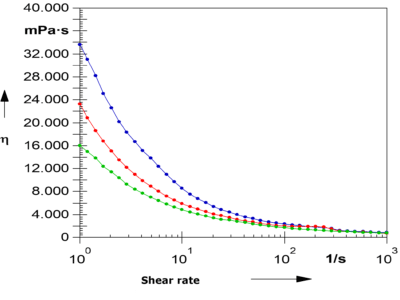
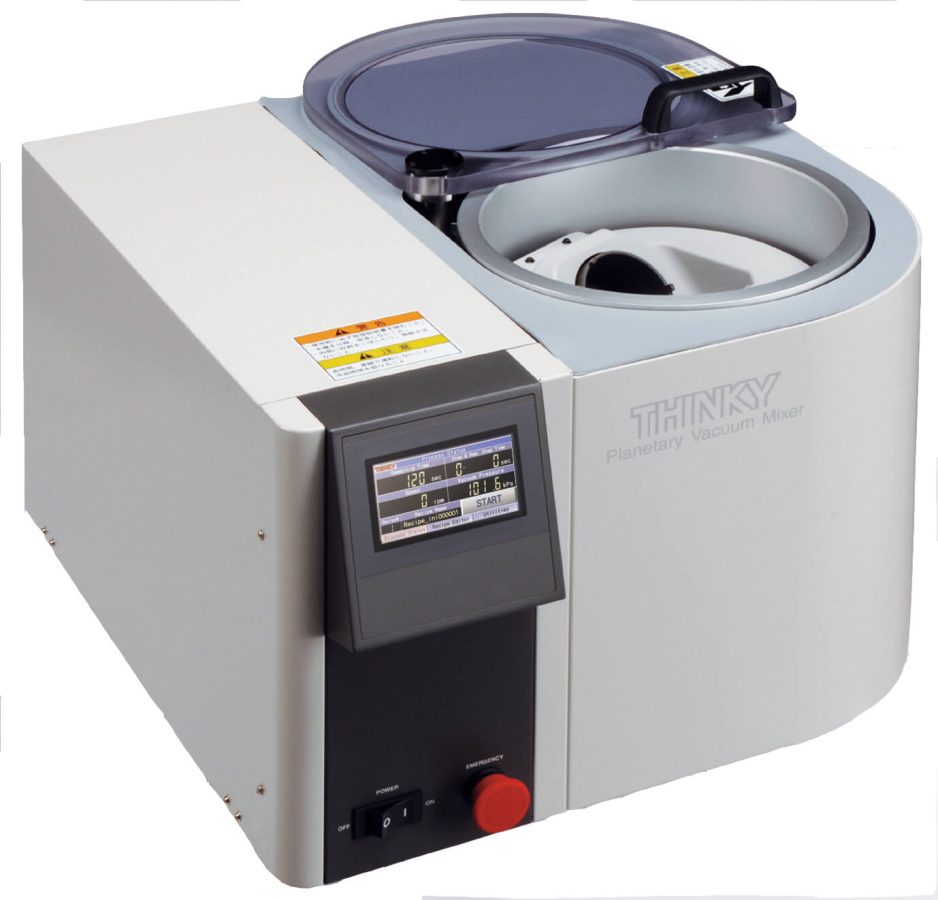
The use of the vacuum rotation/revolution mixer THINKY ARV-310 makes it possible to produce visually homogeneous NMC inks with a solid content in excess of 65% weight in a few minutes. Figure 1 shows that the viscosity decreases with increasing mixing time. Extended mixing times can produce inks of higher solids content with constant viscosity.

Results

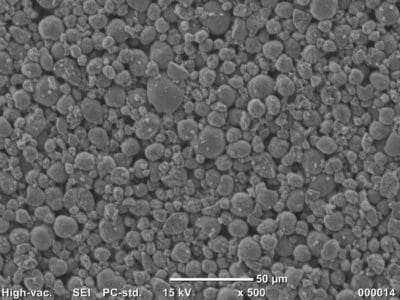
Even better results can be achieved using multi-stage mixing processes. With intermediate steps with very high solid content (>80%), and so very high viscosities, the ink experiences very high shear forces. As a result, carbon black agglomerates are completely pulverised, creating homogeneous coatings, as shown in Figure 2.

The mixing process is extremely effective; electrodes produced in this way with a high active material proportion (96%) have good adhesive properties and flexural strength. These electrodes with high area capacities (>2 mAh/cm2) were also evaluated in coin-cell batteries. In electrochemical tests, they offer high capacities at high rates (~130 mAh/g at 3 C).

Acknowledgement: The research was subsidised by the “ExZellTUM” project run by Germany’s Federal Ministry of Education and Research (BMBF), subsidy number 03X4633A.


Viscosities of NMC coating inks with 65wt% solids for an electrode composition of 96-2-2 (wt%, NMC-carbon black-binder) and with different mixing process durations 8 min, 16 min and 24
Figure 1: Viscosities of NMC coating inks with 65wt% solids for an electrode composition of 96-2-2 (wt%, NMC-carbon black-binder) and with different mixing process durations 8 min, 16 min and 24
SEM images of a doctor blade coating after a multi-stage mixing process. The dispersion of binder and NMC is very homogeneous, with no carbon black agglomerates visible.
Figure 2: SEM images of a doctor blade coating after a multi-stage mixing process. The dispersion of binder and NMC is very homogeneous, with no carbon black agglomerates visible.

Last updated: 9 December 2019

Version: 1.0

Download

Download a printable copy of this resource.