- Products
- Industries
-
-
-
Industries
Browse industry-specific solutions for bonding, coating, and dispensing. Find proven materials and manufacturing technology tailored to your exact requirements.
-
-
-
- Knowledge centre
- News and insights
- About us
-
-
-
About Intertronics
Get a clearer view of the team, facilities and standards behind the technical support offer.
-
-
-
- Contact us
Customer
Institute for Strategic Technology and Precious Metals (STI), Pforzheim University
Customer benefits
- Consistently mixed metal powder and polymer binder
- Powder agglomerates prevented
- Repeatable, controllable process
Introduction
By Prof. Dr.-Ing. C. BURKHARDT, Dr.-Ing. Andreas BAUM, Maximilian MUNGENAST
Lithography-based metal manufacturing (LMM) is a novel indirect additive manufacturing process. The process is based on a step-curing process similar to
stereolithography, building green metal parts from a photopolymer mixture.
The print material (feedstock) is a combination of metal powder and photosensitive polymer binder, which has a very high viscosity. During the print process, layers of the feedstock are selectively cured using UV light. The gradual lowering of the construction platform layer by layer results in a three-dimensional green part, albeit still a complete block of material. This part has enough structural integrity to move on to a two-stage final process.
Firstly, the uncured material is heated up, liquefied, and removed. The part is then sintered to form a non-porous, metallic component with good geometrical
accuracy and very low surface roughness.

Processing feedstock
Firstly, the uncured material is heated up, liquefied, and removed. The part is then sintered to form a non-porous, metallic component with good geometrical accuracy and very low surface roughness.

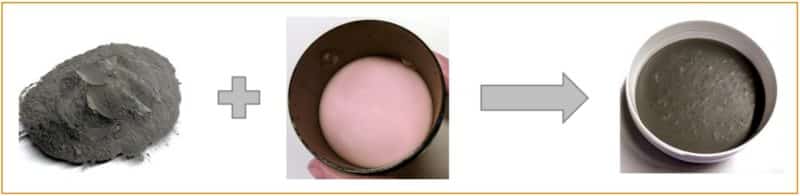
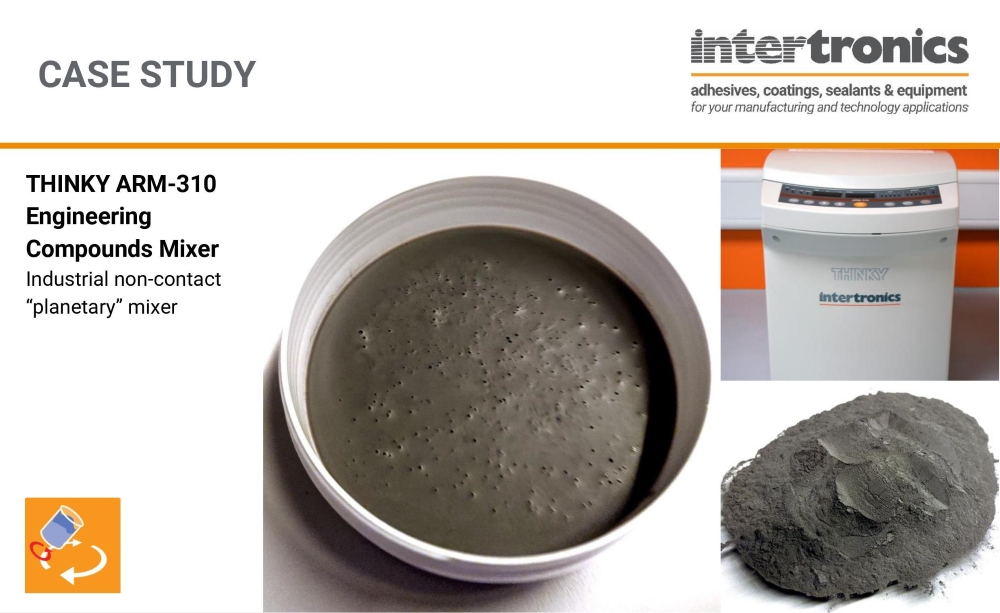
The feedstock, the mixture of metal powder and polymer binder, is critical in forming components with the highest precision and surface quality. It needs to be fully mixed for a reliable, high quality printing process. The THINKY ARM-310 mixing machine is used to ensure the consistent homogeneous mixing. It uses a planetary centrifugal motion (a mix of high-speed rotation and revolution) of the mixing container, which effects the mix with no blades or rollers, despite the high viscosity. Figure 2 shows the components necessary for the production of feedstock.

In preparation for the mixing process, the wax-like polymer binder is heated to melting point. This is then added to the mixing cup in a ratio suitable for the process. Experience has shown that it is beneficial to place the binder into the mixing container first, and then the powder. This prevents powder agglomerates from forming on the bottom of the cup.