Browse industry-specific solutions for bonding, coating, and dispensing. Find proven materials and manufacturing technology tailored to your exact requirements.
Increasing the strength of bondlines on 3D-printed assemblies threefold
Customer benefits
Reliable bonding of long, narrow joints with minimal bonding surface
Ability to create 3D-printed components that are larger than 3D printer working areas
Introduction
3D printing is now established as a manufacturing technology. Due to its increased importance, the demands on quality, material capability and robustness are growing accordingly. For years, our partner relyon plasma GmbH, a subsidiary of TDK Electronics, has been researching plasma activation in 3D printing.
Bonding narrow joints
A significant challenge for Creabis GmbH, a 3D printing service provider, is the 3D printing of large and complex components, as normally 3D printers have maximum component dimensions of ~600mm. To make use of the advantages of 3D printing for larger components, they are printed as individual parts and then bonded together. In practice, predefining joint geometries with maximum bonding area and the assembly itself pose significant challenges. In particular, the strength of the bond is especially critical for long narrow joints where the available bonding surface is minimal.
Functionalising surfaces with plasma
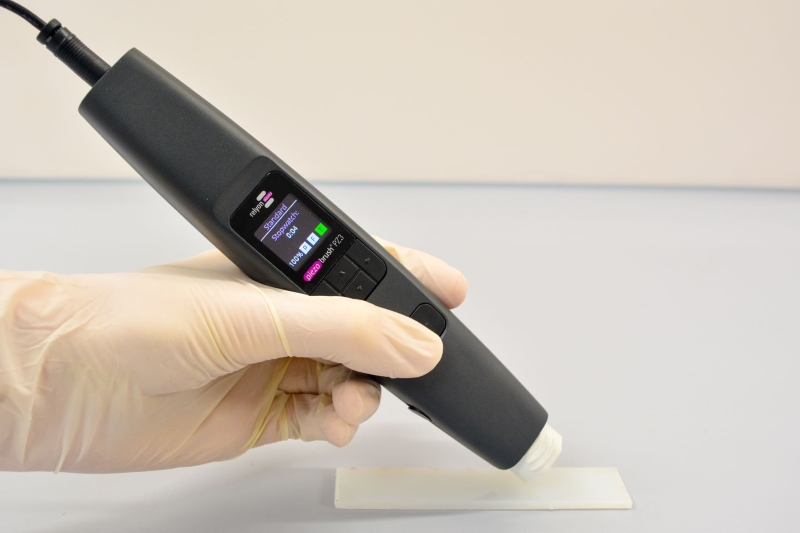
This weakness of 3D printing is, in turn, the strength of relyon plasma GmbH’s technology. If a surface is functionalised with plasma before bonding, the resulting joints show a significant improvement in adhesion. This surface functionalisation through plasma treatment is essentially based on two effects: fine cleaning of the surface from organic contaminants and increasing surface energy for improved wettability by adhesives. The piezobrush® PZ2 – an efficient and compact handheld plasma device from relyon plasma that requires no special technical knowledge or complex infrastructure – is very well-suited for preparing 3D printing parts for bonding. The core of this handheld plasma device is the CeraPlas™ piezo plasma generator – a high-voltage discharge device for generating cold atmospheric pressure plasma.
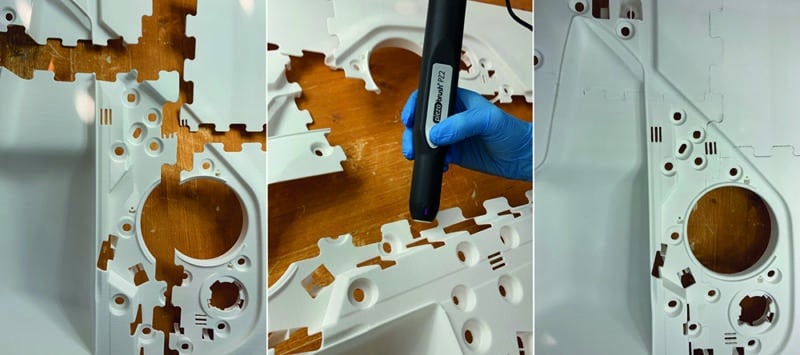
Two applications at Creabis GmbH highlight the potential of the piezobrush PZ2 in the processing of 3D printed parts. The interior door trim of an innovative small series electric vehicle is printed by Creabis from unfilled PA12 by selective laser sintering (SLS) in four individual parts. These are then activated with cold plasma and tacked with cyanoacrylate adhesive. About an hour later, while the parts are still activated, they are structurally bonded with a two-component adhesive. Ralf Deuke, owner of Creabis GmbH, sees the use of plasma technology as extremely advantageous:
“The use of the piezobrush PZ2 now opens up possibilities for bonding individual parts that were previously unthinkable.”
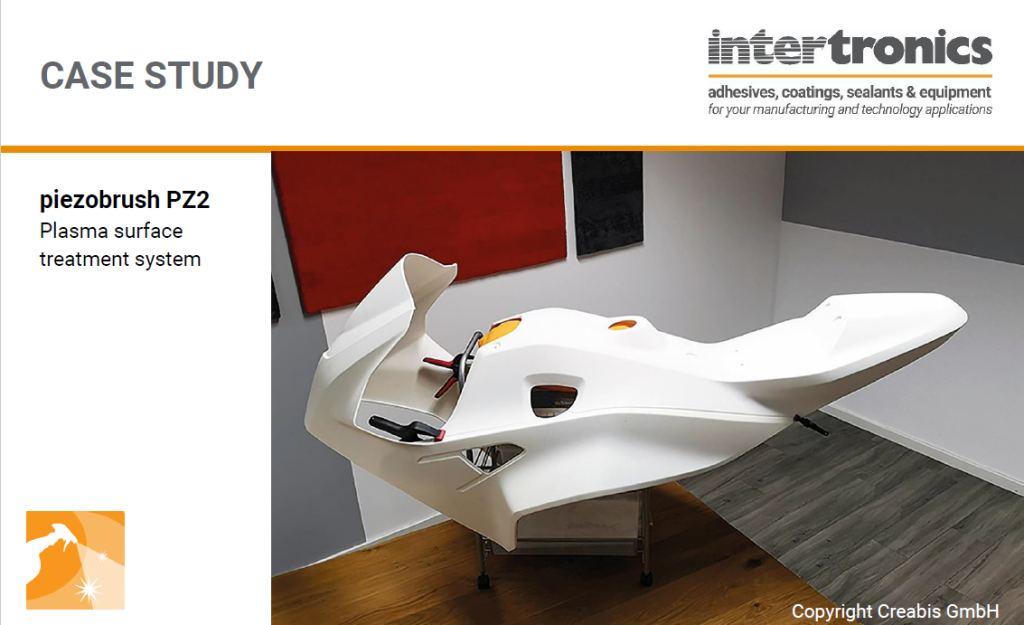
This is particularly the case with the second application example, in which a motorbike fairing for racing is made from 12 individual parts using 3D printing and then bonded after pre-treatment with the piezobrush PZ2. Due to the adhesive strength achieved, the fairing installed on the motorcycle can withstand speeds of over 200 km/h. Internal tests reveal that the components treated with plasma technology have an adhesive bond that is three times stronger than that of untreated parts. Both relyon plasma GmbH and Creabis GmbH are convinced that there are many more applications of plasma technology in 3D printing and will continue to intensify their cooperation in the future.