Browse industry-specific solutions for bonding, coating, and dispensing. Find proven materials and manufacturing technology tailored to your exact requirements.
How MTU Aero Engines is using a liquid mask to revolutionise its surface processing
Customer
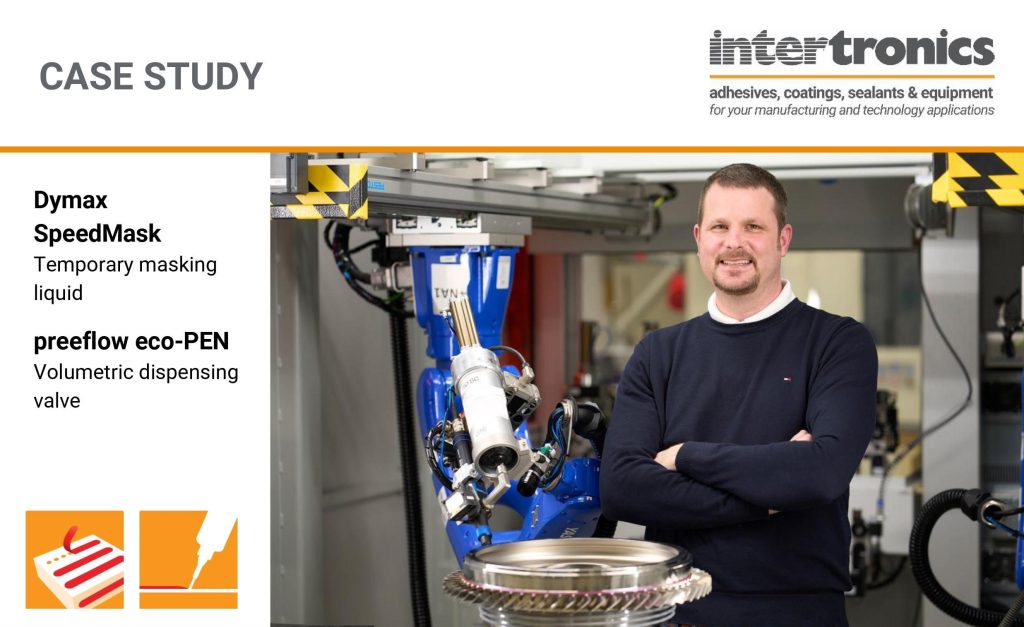
MTU Aero Engines is a military and civil aircraft engine manufacturer and service company based in Munich, Germany. They recently implemented Dymax SpeedMask temporary masking liquid into their processes. Here is MTU’s story in their own words.
Customer benefits
Masking programs automated and independently adaptable
Application of masking reduced from 4 hours to 14 minutes
Meeting nearly zero tolerance levels in application accuracy
Reduction of waste and scrap
Introduction
When Thomas Kaltenecker, a production planner at MTU Aero Engines, wants to explain the purpose and utility of his futuristic dispensers, he places two photos
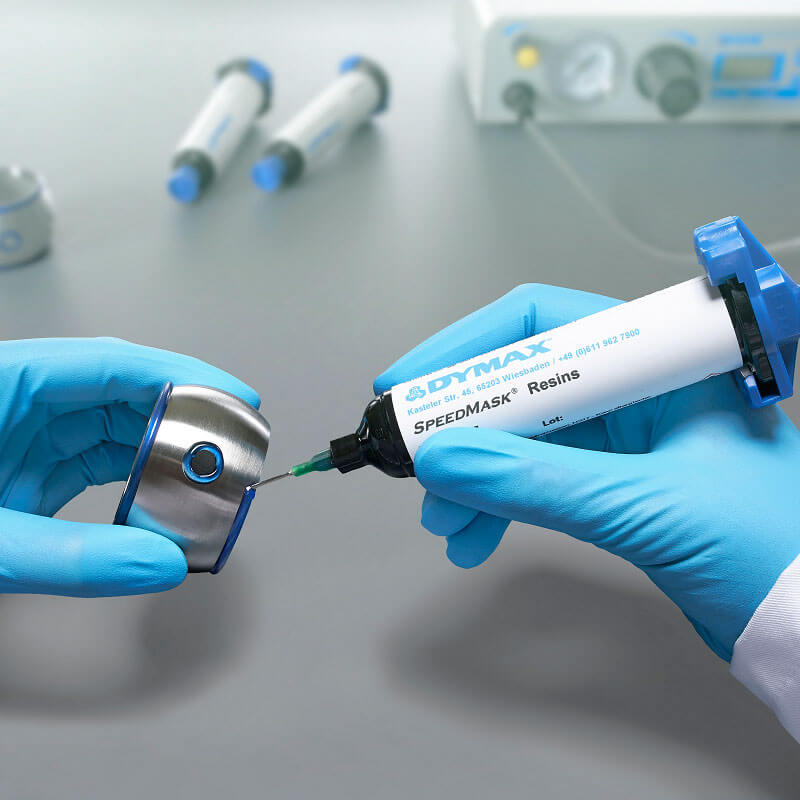
side by side. The picture on the left shows a large storage facility with multiple floors of silicone rings in dozens of different colours, shapes and sizes hung over, under and alongside each other. The picture on the right shows a few cartridges filled with a gel-like elastomer lying on a table. “Ultimately, both fulfil the same task,” Kaltenecker explains, “namely covering over certain areas of engine components with masking material while other areas that are subject to particularly strong stresses and strains are given, say, a thermal spray coating. The masking makes sure the spray coating doesn’t get onto areas where it’s not supposed to be.”
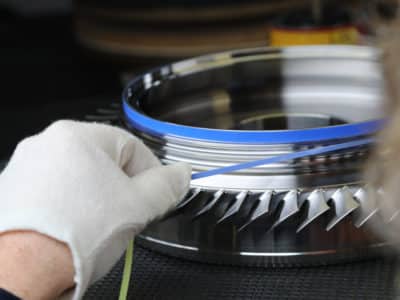
Kaltenecker’s colleagues manually attach, pull on, fit and clamp the adhesive tape, silicone rings, masks or metal covers to these areas at a precision down to fractions of a millimetre. By contrast, the dispensers apply the elastomer in a fully automated manner to the respective sections on the component. Then the fully automatic masking machine’s UV lamp cures the material in seconds. After the masking has passed through the respective manufacturing process, such as thermal coating, shot blasting or electroplating, it can be pulled off the component without leaving any residues behind.
Shorter throughput times, improved quality and reduced costs
SpeedMask® is the brand name of the viscous gel, and DYMAX is the name of the manufacturer. This company’s UV light curing adhesives are used primarily in the domain of medical engineering; Kaltenecker heard about the product by chance. “Stuff like that could really be useful in our coating processes,” he thought to himself.
Step by step, Kaltenecker began to experiment with DYMAX SpeedMask®. He tried out various material blends and masking processes—at this point still working manually. Initial tests yielded promising results. Gradually, he found himself spending more and more time not just planning production, but also developing a new masking technique. At the same time, student research projects were busy investigating elastomer 3D printing on engine parts. They attested to its technical feasibility and broad range of applications in MTU production. Shorter throughput times, improved quality and reduced costs deliver first-rate added value.
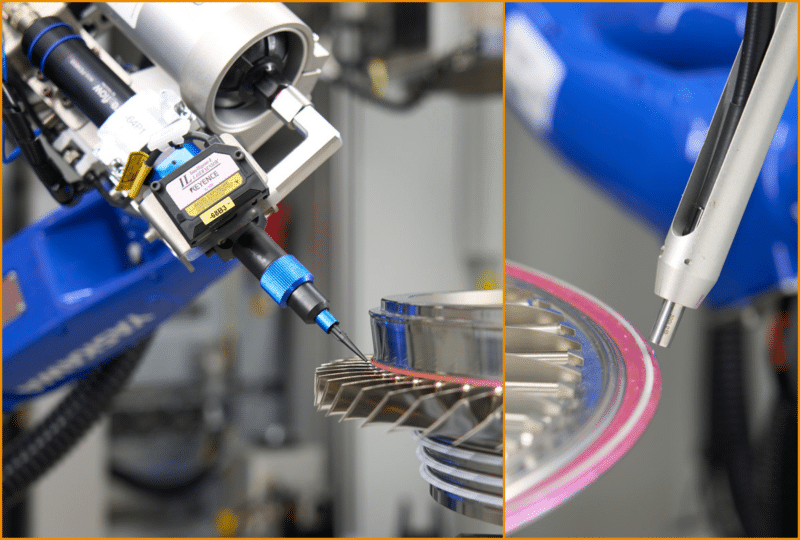
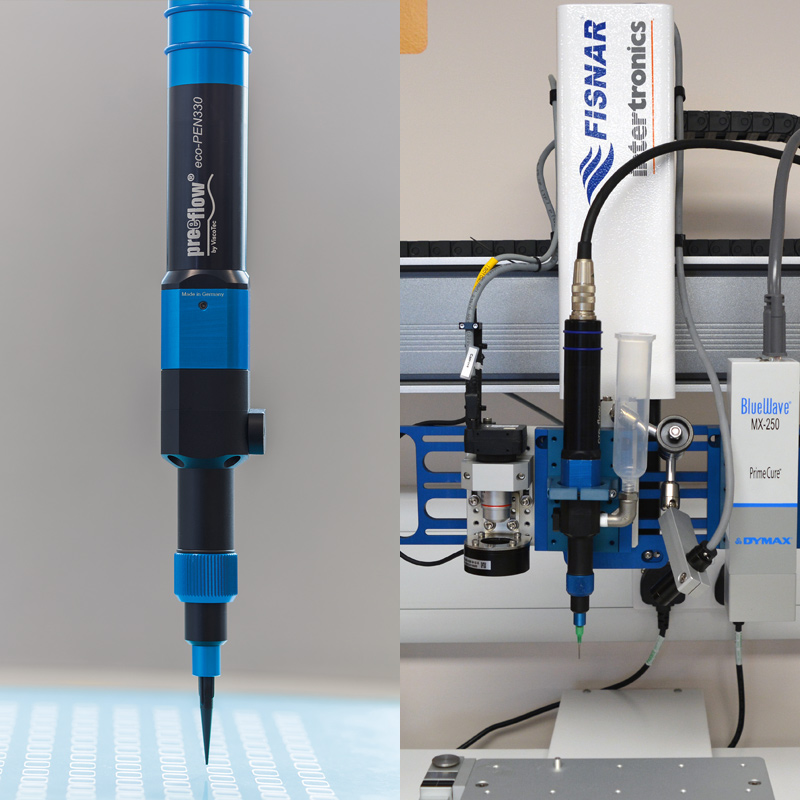
For over three years now, Kaltenecker’s working day has revolved largely around SpeedMask®—and as he tells his story, a blisk revolves in the robot cell behind him. The machine’s optics have recognised that it is dealing with the fourth stage of a specific high-pressure compressor. The control unit loads the corresponding program, sets up the correct dispenser and moves it into position. While the rotary table turns, tilts, lifts and lowers the component, the preeflow eco-PEN dispenser continuously conveys elastomer from the cartridge. The material is applied along edges with exactly the high precision that is required for tasks like masking on thin blisk blade tips. But the machine can also fill drilled holes or apply masking over broad areas. This process and the fully automatic machine make for an almost endless range of possible applications and variations. “The exact shape of the specific mask is defined by the respective process parameters, such as the type of dispenser attachment, the distance and angle of the dispenser to the component, and the flow rate,” Kaltenecker explains. Then the UV lamp buzzes past and cures the elastomer.
SpeedMask is precisely applied to the blisk with a preeflow eco-PEN, then cured in seconds with UV light
Finally, the machine’s optics come into play again: “They can spot, for example, whether there are unwanted little air bubbles or imperfections in the masking.” That means quality control is included—and there’s a benefit in sustainability terms, too: “Up to now, we’ve been rejecting around 14,000 silicone rings a year at incoming goods on account of deviations. These rejects end up as scrap.”
Surfaces masked to virtually zero tolerance levels
Last summer saw the delivery of a prototype system—one that is quite probably unparalleled worldwide—that enables MTU production to use the innovative material for masking turbine components in a fully automated and effective manner. After putting the system through testing, attention turned to its industrialisation: in other words, setting up the masking and curing programs for the first components. While this summary of the machine’s life story up to the present day sounds pretty brief, in fact the backstory is already lengthy: “The prototype was definitely one of our most challenging projects to date,” explains Pascal Malischek, mechatronics and robotics engineer for the Austrian manufacturer Robooptic Systems. “The machine’s entire control system is built in a sort of modular design with free parameters, so that MTU can adapt the masking programs independently.”
This programmability was decisive from MTU’s perspective. Several hundreds of components from the portfolio often pass through various coating stations during their production. Occasionally, component geometries change in the course of design improvements. “In those instances, we have to be able to adjust the respective SpeedMask® masking programs quickly and easily,” Kaltenecker says.
The production planner points to the efficiency aspect of the new system, as regards both OEM and MRO business: “The areas that need to be masked off have become so fine and intricate that masking them by hand takes huge concentration and an inordinate amount of time.” Tasks that took what felt like an eternity to do manually, the SpeedMask® robot gets done in a fraction of the time. “Especially now, with the sharp increase in production for the new programs, this is a big relief for colleagues.” In addition, the material can be processed mechanically, meaning that surfaces can be masked virtually to zero tolerance levels and there is scarcely any limit on the contours that can be produced.
But the advantages of the innovative masking process don’t end there: in certain situations, the masking is applied just once and then used for several successive production steps. This also saves a lot of time and money. And in the MRO sector, the machine could help create customised masking for the repair of worn engine parts.
The new masking method opens up new potential in engine development
Finally, one other aspect is sure to have a general effect on engine efficiency of engines. “There are places inside the engine that developers would like to improve,” Kaltenecker explains. “But some of their clever ideas were impossible for us to implement before now, because we were unable to get the masking done precisely enough with the adhesive tapes, silicone rings, masks and metal covers we were using.” Of course, validation is required case by case, he notes. But at least now there is a suitable process and a suitable machine on hand.
Why SpeedMask is worth considering
“SpeedMask has a lot of benefits. Both application and removal are much faster than other methods such as tapes, it can be applied to a broad range of geometries, and if it’s cured correctly SpeedMask doesn’t leave residue on the surface after removal,” says Matt Baseley, Technical Sales Executive at Intertronics.
“In addition, the process of applying SpeedMask can be easily automated, freeing up staff for other tasks. SpeedMask offers return on investment predominantly through its speed of application and removal and the fact that rework arising from leakage or residue around tapes isn’t required with SpeedMask. Therefore, it not only saves labour around application and removal, but it also potentially saves a whole step in the process.
“To achieve the tightest tolerances in SpeedMask application, I would recommend the preeflow eco-PEN or eco-SPRAY volumetric dispensing or spray valves. They are highly repeatable, have an accuracy of ±1%, >99% of the time, are viscosity independent and easily automated.
“What MTU have put together, between their automated system and their choice of material, is really savvy engineering, and combines several best-in-class technologies to create something that will significantly benefit their productivity for years to come. Congratulations to Thomas and his colleagues for achieving such substantial process improvement.”
Read more
You can read more about MTU’s cutting-edge technology at MTU AeroReport – their in-house aviation magazine, including their version of this case study with additional photos.


 When Thomas Kaltenecker, a production planner at MTU Aero Engines, wants to explain the purpose and utility of his futuristic dispensers, he places two photos