Browse industry-specific solutions for bonding, coating, and dispensing. Find proven materials and manufacturing technology tailored to your exact requirements.
Adhesion plays a decisive role for product quality and process stability in many areas of the electronics industry. These include bonding and marking of plastic components, wire bonding processes on metallic contact pads and the development of energy storage devices.
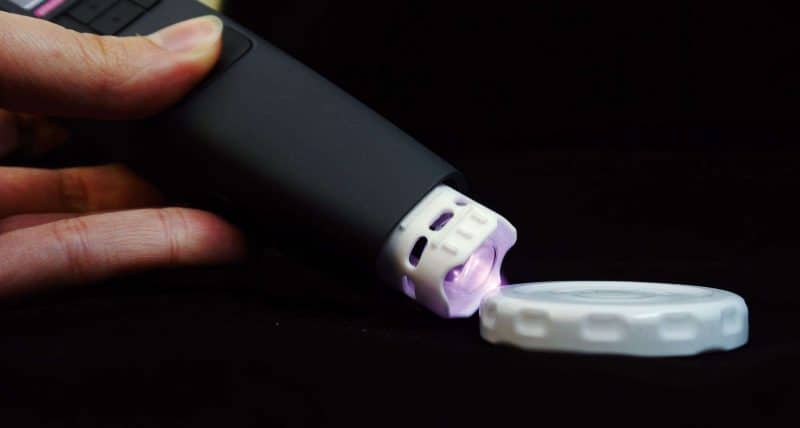
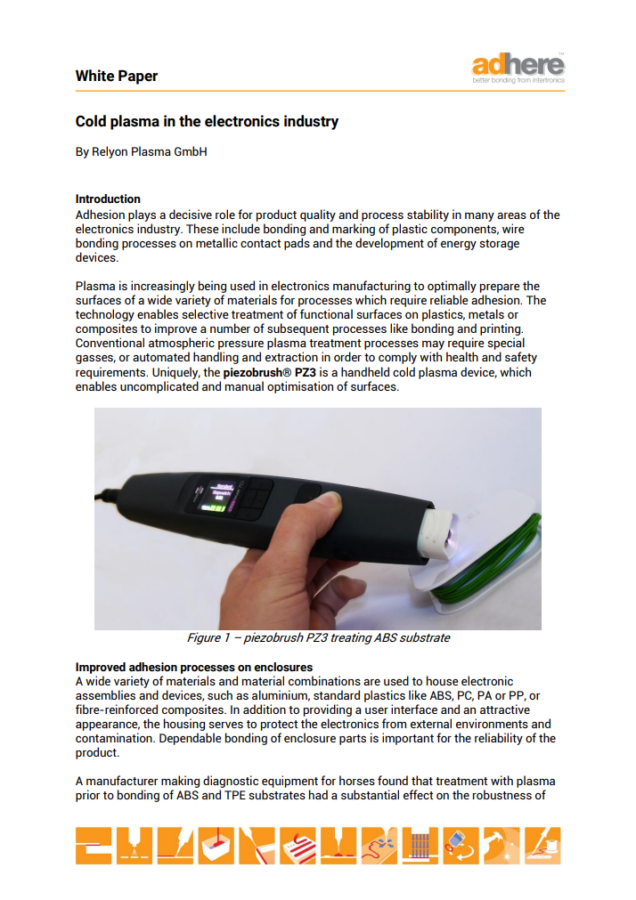
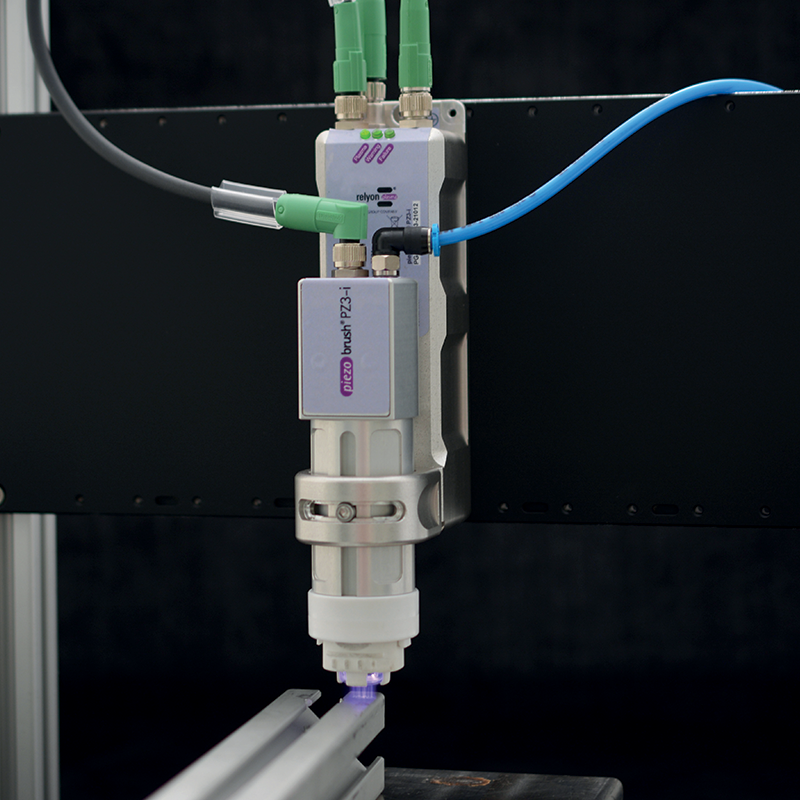
Plasma is increasingly being used in electronics manufacturing to optimally prepare the surfaces of a wide variety of materials for processes which require reliable adhesion. The technology enables selective treatment of functional surfaces on plastics, metals or composites to improve a number of subsequent processes like bonding and printing. Conventional atmospheric pressure plasma treatment processes may require special gasses, or automated handling and extraction in order to comply with health and safety requirements. Uniquely, the piezobrush® PZ3 is a handheld cold plasma device, which enables uncomplicated and manual optimisation of surfaces.
Figure 1 – piezobrush PZ3 treating ABS substrate
Improved adhesion processes on enclosures
A wide variety of materials and material combinations are used to house electronic assemblies and devices, such as aluminium, standard plastics like ABS, PC, PA or PP, or fibre-reinforced composites. In addition to providing a user interface and an attractive appearance, the housing serves to protect the electronics from external environments and contamination. Dependable bonding of enclosure parts is important for the reliability of the product.
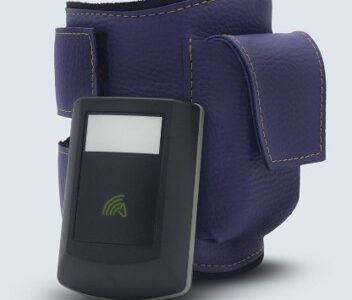
A manufacturer making diagnostic equipment for horses found that treatment with plasma prior to bonding of ABS and TPE substrates had a substantial effect on the robustness of the finished product, making it viable in an outdoor environment and for use with large animals.1
Figure 2 – This sensor is placed in a cuff on a horse’s leg, so the assembly must be robust
The surfaces of the typically used housing materials are often repellent to dirt and humidity, but also to adhesives, printing inks or varnishes. In many cases this leads to insufficient adhesion of the bonding of housings or to inferior quality of labelling or design elements. These problems are primarily due to the insufficient wettability of the used materials. By treating the surfaces with cold atmospheric pressure plasma, the wettability can be improved in a targeted manner. This can be demonstrated by analysing the contact angle between a test liquid, such as water, and the plastic surface: the smaller the contact angle, the flatter the drop and the better the wettability.
Good wettability is a necessary parameter for an optimised subsequent process such as bonding or printing. Thanks to the compact and inexpensive Piezo Direct Discharge (PDD) technology® used in the piezobrush PZ3 handheld device, there is now a low investment threshold for access to plasma technology to improve the surface properties of enclosure parts.
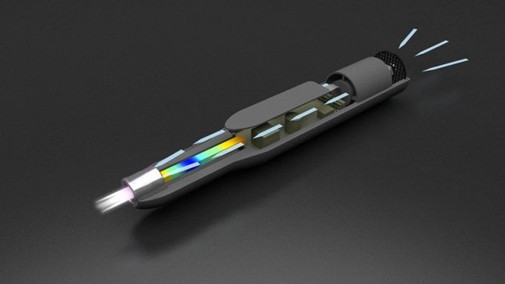
Figure 3 – Piezoelectric Direct Discharge (PDD®) technology is based on the direct electrical discharge at an open piezoelectric transformer (PT). The heart of the technology is the TDK CeraPlas™ plasma generator, a high-voltage discharge component for compact plasma generation.2
Cold plasma technology
Conventional plasma systems are available in two formats: low-pressure systems are based on chambers, which are batch loaded with parts. Gas is introduced and subsequently energised to generate the plasma. After treatment, the chamber is evacuated and the parts removed, ready for the next batch. Alternatively, there are also inline-capable atmospheric pressure plasma systems. As a rule, these are integrated into automated production; they require process control to prevent over-treatment or temperature damage of substrates such as plastics, extraction, and protection of employees from the hazards of the plasma flame.
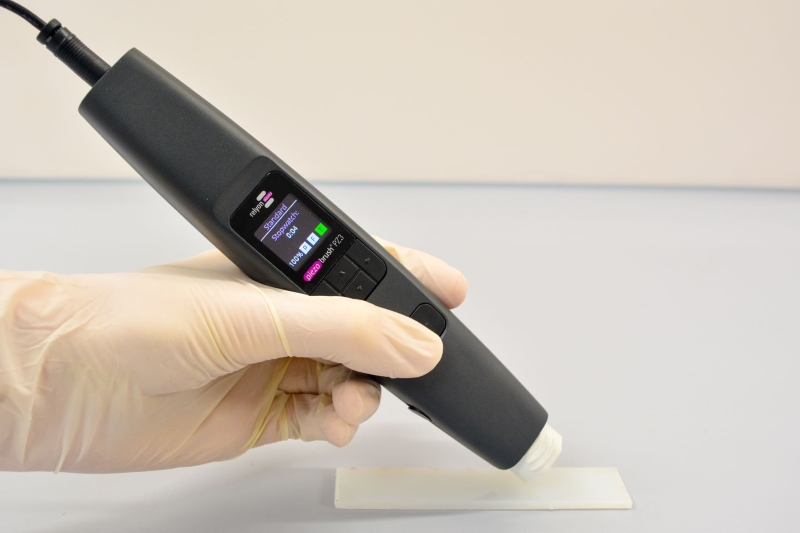
The handheld piezobrush PZ3 plasma held device is more straightforward. The plasma discharge generated using PDD Technology does not involve significant heat and requires only 18 W of power. This makes the piezobrush safe for the operator, and also for any temperature-sensitive materials, such as thin plastic foils. It is an affordable option for start-ups and smaller businesses who cannot justify the more expensive batch or in-line systems.
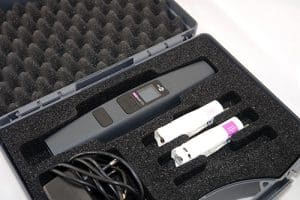
The heart of the piezobrush PZ3 is the CeraPlas piezoelectric plasma generator from TDK. The approximately 7 cm long component efficiently transforms a small input voltage by several factors so that a cold plasma can be ignited under ambient conditions without the addition of special gases. It is located in a readily replaceable, plug and play module for the PZ3; there is a Standard module, and a Nearfield module for conductive substrates.
Figure 4 – piezobrush PZ3 with Standard and Nearfield nozzles
This plasma does not exceed a temperature of 50°C and is a mixture of highly reactive ions, radicals and neutral particles. The oxygen-based reagents are particularly effective for the functionalisation of plastics. By treating typically hydrophobic plastics with the piezobrush PZ3 using the Standard module, the resultant oxygen species accumulate as polar end groups on the molecules of the surface. These act as bonding “anchors”, help to form strong bonds to adhesives, inks or coatings.
The piezobrush PZ3 can also be used for ultra-fine cleaning of metals or semiconductors, using the Nearfield module. For example, one such manufacturer found that they were able to treat semiconductor components to optimise them for further processing. The company has developed its own LiDAR technology based on patented silicon micro-electromechanical system (MEMS) mirrors and commercially available components.3
Process optimisation in wiring
The insulating sheathing of cables often presents an adhesion challenge during assembly and marking. A wide variety of polymers are used: for example, PE, PVC, PC, PTFE (Teflon®) or PI (Kapton®), and many of these have low surface energies and poor wetting. Adhesion problems can occur in processes such as bonding, encapsulation or over-moulding of connectors, which may only become noticeable under temperature cycling or vibration. Pre-treatment of both wire insulation and connector bodies can alleviate this.
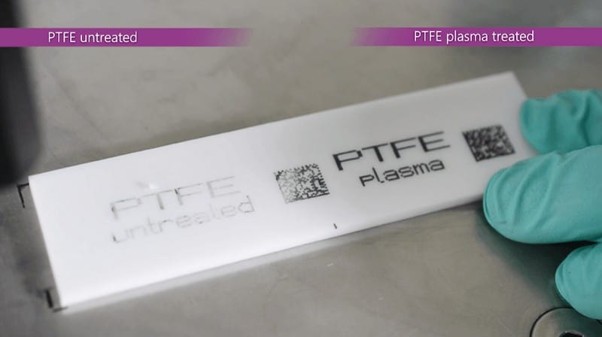
Reliable marking or printing of cable insulation relies on good adhesion of the ink – issues like inferior image quality or permanence can be improved using plasma. An example print on a PTFE substrate shows that even on this highly repellent material, a standard inkjet ink adheres much better to the plasma-treated side of the test coupon.
Figure 5 – Adhesion test of inkjet printing on untreated and plasma-treated PTFE
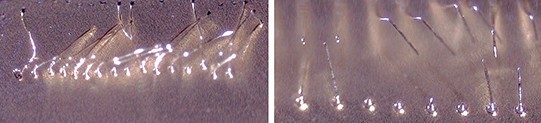
In the field of interconnects, a wire bonding company was able to more than double the shear force value of their wire bonds on the contact surfaces of batteries by treating them with the piezobrush PZ3 using the nearfield module. This process acts as a selective fine cleaning step to remove contamination and residues from the contact surfaces prior to the wire bonding step.4
Figure 6 – Pull tests of wire bonds on untreated and plasma pre-treated ENEPIG surface
Plasma-supported production processes for energy storage systems
In addition to battery connection, other processes in the production of energy storage devices can be optimised using cold atmospheric pressure plasma. There is still a lot of research potential in the area of internal structure for energy storage systems with liquid electrolytes. For example, plasma technology helps to improve the wetting of bipolar plates with liquid electrolytes, as used in fuel cells. In principle, the piezobrush PZ3 handheld device can be used to selectively modify the wetting properties of surfaces.
Conclusion
These examples of applications for the piezobrush PZ3 in the electronics industry illustrate the wide range of potential benefits derived from its compact cold plasma technology. From adhesion improvement in bonding, coating or printing on standard and challenging substrates, to applications in wire bonding and development projects in energy storage. Easy handling and intuitive operation make the piezobrush PZ3 suitable for use in manual or semi-automated production, new product development, and in research and development settings such as laboratories.