- Products
- Industries
-
-
-
Industries
Browse industry-specific solutions for bonding, coating, and dispensing. Find proven materials and manufacturing technology tailored to your exact requirements.
-
-
-
- Knowledge centre
- News and insights
- About us
-
-
-
About Intertronics
Get a clearer view of the team, facilities and standards behind the technical support offer.
-
-
-
- Contact us
Customer
Compound semiconductor manufacturer
Customer benefits
- Consistently homogenised compound
- Process times reduced from hours to minutes
- Easy set up
Introduction
One of the final processes in the packaging of compound semiconductors is encapsulation with a multi-part resin, which requires metering, mixing and degassing before application and then heat curing. For one such manufacturer of these components, the process of preparing the compounds by hand was causing an inconsistent, labour intensive final product.
Challenge
The original production process involved mixing materials with a spatula and then placing the resulting compound within a vacuum degassing machine to remove all air traces. This process, which required constant supervision, could take up to several hours to degas the high viscosity resin, adding time and reducing staff efficiency.
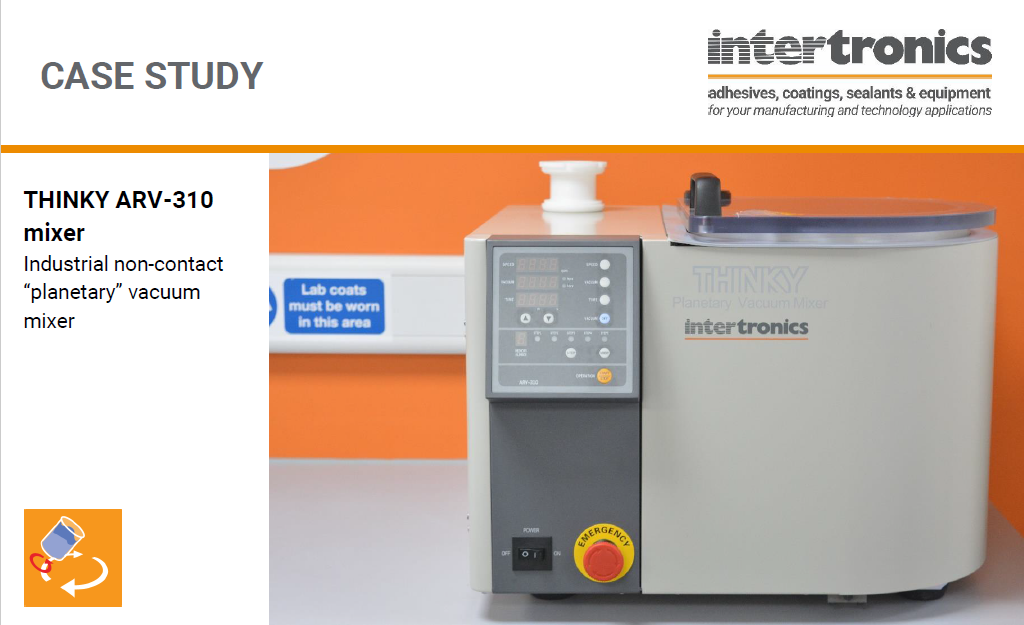
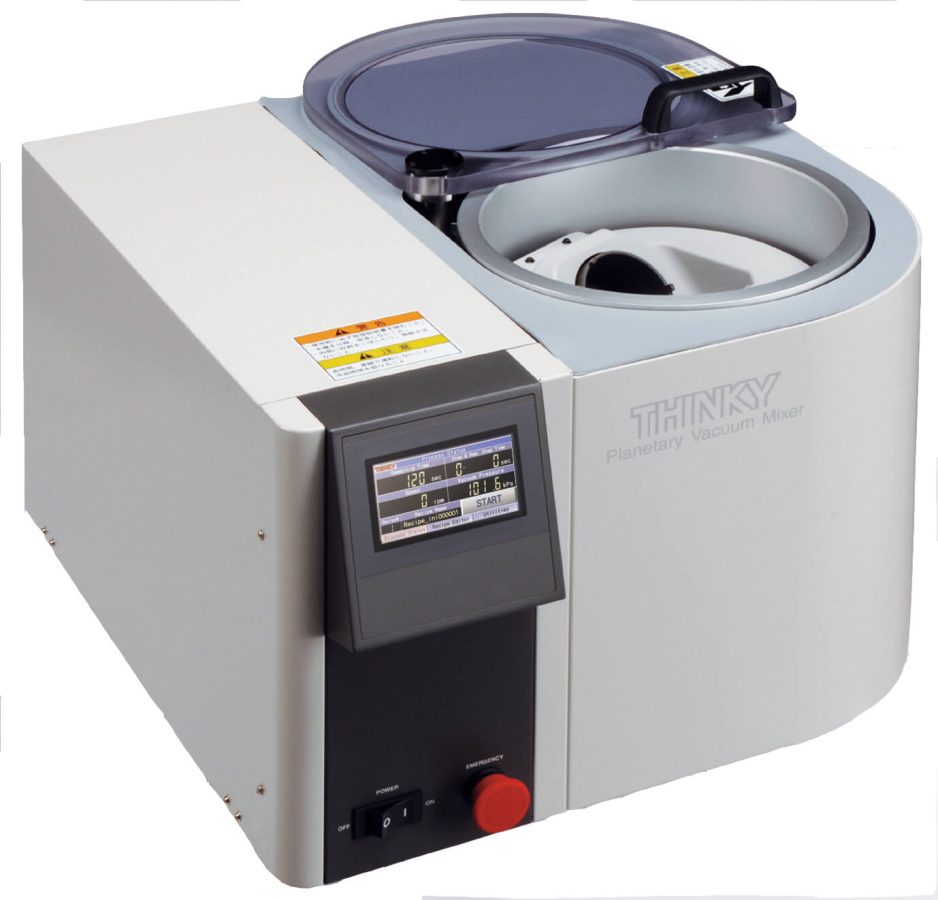
Seeking a more efficient method of mixing their compounds, the manufacturer in question contacted THINKY and arranged a demonstration of their ARV-310 unit. The chosen mixer, which uses a non-contact “planetary” mixing method, processes all engineering compounds regardless of viscosity, making it suitable for the manufacturer’s requirements. With the integral vacuum capability of the ARV-310 mixing and degassing machine, the user is able to simultaneously mix and degas up to 310g of material in seconds to minutes, removing any micro-bubbles to a high level.

Results
By running the mixer through a series of tests the team observed a significant improvement in mixing uniformity as worker-related variation was eliminated through a consistent, automated process. They also realised time efficiencies of up to 90% as mixing and degassing processes could take place simultaneously, reducing production time from hours to minutes and allowing staff to attend to other tasks within the factory.