- Products
- Industries
-
-
-
Industries
Browse industry-specific solutions for bonding, coating, and dispensing. Find proven materials and manufacturing technology tailored to your exact requirements.
-
-
-
- Knowledge centre
- News and insights
- About us
-
-
-
About Intertronics
Get a clearer view of the team, facilities and standards behind the technical support offer.
-
-
-
- Contact us
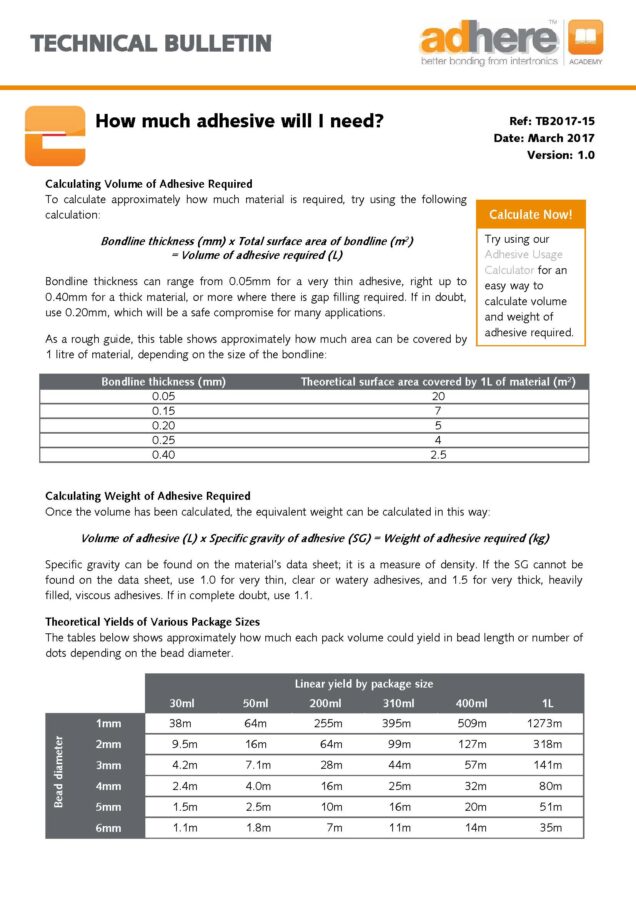
Calculating Volume of Adhesive Required
To calculate approximately how much material is required, try using the following calculation:
Bondline thickness (mm) x Total surface area of bondline (m2)
= Volume of adhesive required (L)
Bondline thickness can range from 0.05mm for a very thin adhesive, right up to 0.40mm for a thick material, or more where there is gap filling required. If in doubt, use 0.20mm, which will be a safe compromise for many applications.
As a rough guide, this table shows approximately how much area can be covered by 1 litre of material, depending on the size of the bondline:
| Bondline thickness (mm) | Theoretical surface area covered by 1L of material (m2) |
|---|---|
| 0.05 | 20 |
| 0.15 | 7 |
| 0.20 | 5 |
| 0.25 | 4 |
| 0.40 | 2.5 |
Calculating Weight of Adhesive Required
Once the volume has been calculated, the equivalent weight can be calculated in this way:
Volume of adhesive (L) x Specific gravity of adhesive (SG) = Weight of adhesive required (kg)
Specific gravity can be found on the material’s data sheet; it is a measure of density. If the SG cannot be found on the data sheet, use 1.0 for very thin, clear or watery adhesives, and 1.5 for very thick, heavily filled, viscous adhesives. If in complete doubt, use 1.1.
Theoretical Yields of Various Package Sizes
The tables below shows approximately how much each pack volume could yield in bead length or number of dots depending on the bead diameter.
Linear yield by package size
| Bead dimeter | 30ml | 50ml | 200ml | 310ml | 400ml | 1L |
|---|---|---|---|---|---|---|
| 1mm | 38m | 64m | 255m | 395m | 509m | 1273m |
| 2mm | 9.5m | 16m | 64m | 99m | 127m | 318m |
| 3mm | 4.2m | 7.1m | 28m | 44m | 57m | 141m |
| 4mm | 2.4m | 4m | 16m | 25m | 32m | 80m |
| 5mm | 1.5m | 2.5m | 10m | 16m | 20m | 51m |
| 6mm | 1.1m | 1.8m | 7m | 11m | 14m | 35m |
Number of dots yielded by package size
| Bead dimeter | 30ml | 50ml | 200ml | 310ml | 400ml | 1L |
|---|---|---|---|---|---|---|
| 2mm | 7,160 | 11,940 | 47,800 | 74,000 | 95,500 | 238,700 |
| 4mm | 900 | 1,500 | 6,000 | 9,300 | 12,000 | 29,900 |
| 6mm | 270 | 450 | 1,800 | 2,800 | 3,600 | 8,900 |
| 8mm | 120 | 190 | 800 | 1,200 | 1,500 | 3,800 |
| 10mm | 60 | 100 | 400 | 600 | 800 | 2,000 |
These theoretical values are calculated where the bead line is an assumed circle and the bead diameter is measured from the dispenser. They are intended as a guide only.
Points to Consider
- Allow for wastage in the volume calculated. Wastage can occur from using mixing nozzles, material feeds from pressure pots or other reservoirs – particularly in the tubing, requiring purging in the process and more.
- Allow for process error in the volume calculated, for example, human error.
- Consider the properties of the substrates the adhesive is being applied to, for example the absorbency or condition of the substrate.
This technical bulletin and Adhesive Usage Calculator should be used as a rough guide to understand how much adhesive you may need. For more help with calculating how much adhesive you will need, please contact our product specialists who can advise based on your specific needs.