Browse industry-specific solutions for bonding, coating, and dispensing. Find proven materials and manufacturing technology tailored to your exact requirements.
Static mixing nozzles are essential dispensing consumables used for the successful mixing of two-part materials. Available in a range of shapes and sizes, selecting the most appropriate nozzle for your application can be a challenge. This guide outlines the key factors to consider when choosing a nozzle.
Introduction
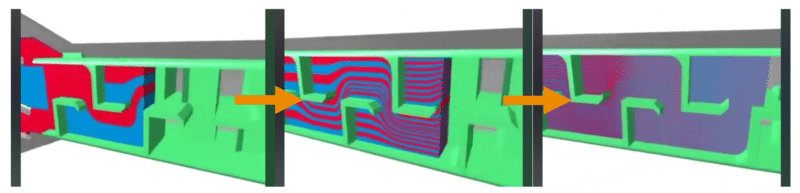
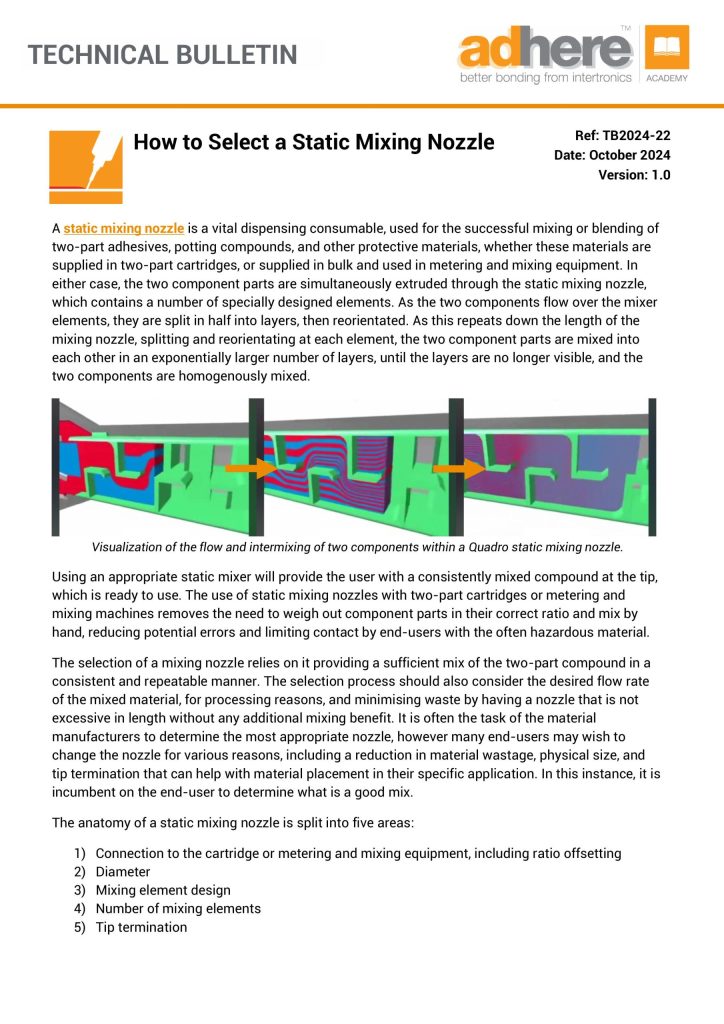
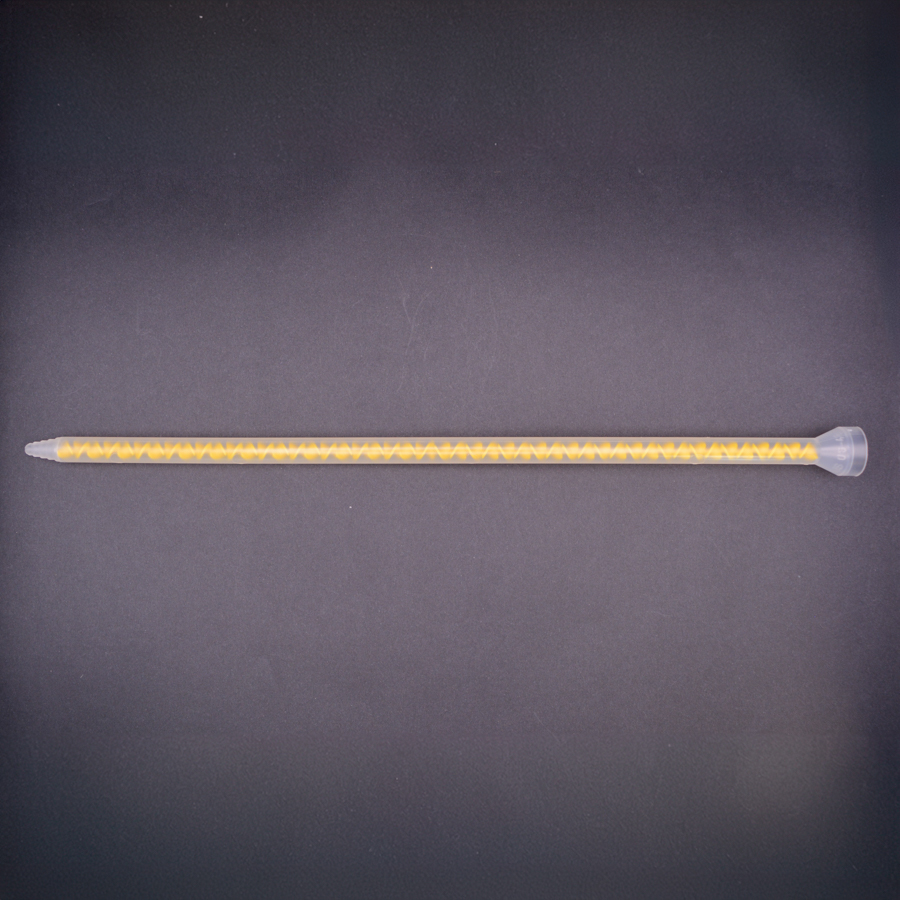
A static mixing nozzle is a vital dispensing consumable, used for the successful mixing or blending of two-part adhesives, potting compounds, and other protective materials, whether these materials are supplied in two-part cartridges, or supplied in bulk and used in metering and mixing equipment. In either case, the two component parts are simultaneously extruded through the static mixing nozzle, which contains a number of specially designed elements. As the two components flow over the mixer elements, they are split in half into layers, then reorientated. As this repeats down the length of the mixing nozzle, splitting and reorientating at each element, the two component parts are mixed into each other in an exponentially larger number of layers, until the layers are no longer visible, and the two components are homogenously mixed.
Visualization of the flow and intermixing of two components within a Quadro static mixing nozzle. The two component parts are mixed into each other in an exponentially larger number of layers, until the layers are no longer visible, and the two components are homogenously mixed.
Using an appropriate static mixer will provide the user with a consistently mixed compound at the tip, which is ready to use. The use of static mixing nozzles with two-part cartridges or metering and mixing machines removes the need to weigh out component parts in their correct ratio and mix by hand, reducing potential errors and limiting contact by end-users with the often hazardous material.
The selection of a mixing nozzle relies on it providing a sufficient mix of the two-part compound in a consistent and repeatable manner. The selection process should also consider the desired flow rate of the mixed material, for processing reasons, and minimising waste by having a nozzle that is not excessive in length without any additional mixing benefit. It is often the task of the material manufacturers to determine the most appropriate nozzle, however many end-users may wish to change the nozzle for various reasons, including a reduction in material wastage, physical size, and tip termination that can help with material placement in their specific application. In this instance, it is incumbent on the end-user to determine what is a good mix.
The anatomy of a static mixing nozzle is split into five areas:
Connection to the cartridge or metering and mixing equipment, including ratio offsetting
Diameter
Mixing element design
Number of mixing elements
Tip termination
Connection
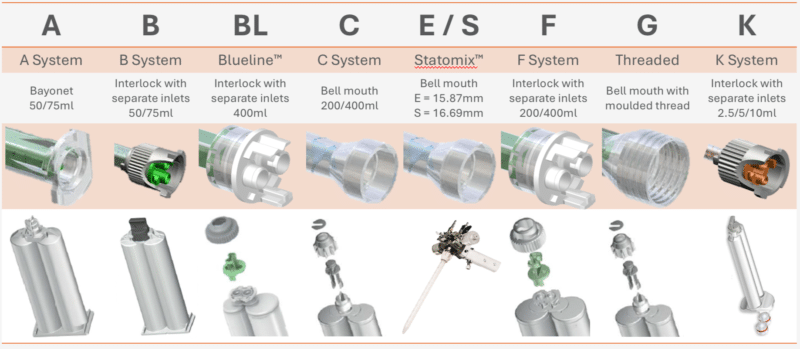
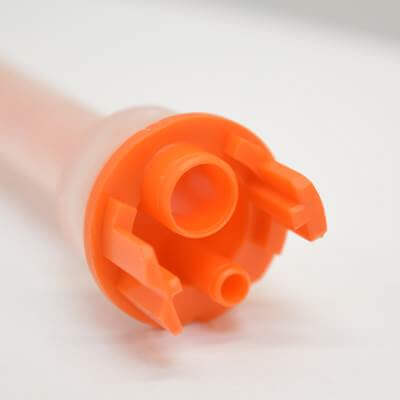
For many years, few connection options existed, with small bayonet fittings for 50ml cartridges and larger bell-mouth connections for 200ml cartridges and metering and mixing equipment. Nowadays, a variety of connections exist in the market, with a trend toward designs that keep materials separate further into the nozzle to help prevent cross-contamination. Moreover, if a material has a ratio of 4:1 or greater, some nozzles are designed specifically to restrict flow of the smaller components to increase pressure into the nozzle to encourage incorporation.
Medmix MIXPAC™ have four core connection types (A System, B System, C System, and F System) and then variations on these themes. The different types relate to their corresponding cartridge and still include the traditional fitments. The B and F types, in addition to the separated inlets, provide operators or end-users with poka-yoke (Japanese for ‘mistake-proof’) design feature to further ensure materials are not cross-contaminated as they can only be attached in one orientation.
Comparison table of mixing nozzle connection types. A System: Bayonet 50/75 ml. B System: Interlock with separate inlets 50/75 ml. BL Blueline System: Interlock with separate inlets 400 ml. C System: Bell mouth 200/400 ml. E/S Statomix System: Bell mouth, E=15.87 mm, S = 16.69 mm. F System: Interlock with separate inlets 200/400 ml. G Threaded System: Bell mouth with moulded thread. K System: Interlock with separate inlets 2.5/5/10 ml.
Diameter
The diameter refers to the inner diameter of the mixer in which the mixing elements sit. This cross-sectional dimension directly influences flow rate through the nozzle, and back-pressure. Materials that have a significant viscosity and/or ratio difference can benefit from an increased back-pressure, induced by narrower diameter mixers and higher flow rates, which provides better mixing forces. If both components are low viscosity, mixing can benefit from narrower diameters that create increased turbulence. If a high flow rate is required, the trade-off is typically to increase diameter and the number of mixing elements.
Mixing element design
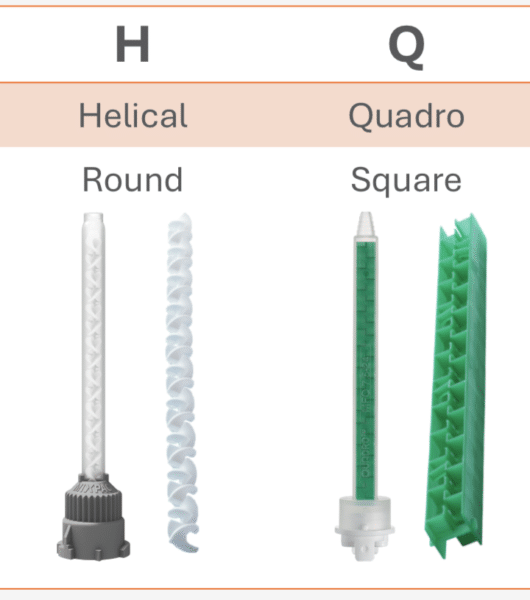
The choice of element design is based how the material behaves and how efficiently mixing can be achieved. Current thinking considers the Medmix MIXPAC Quadro™ to be the leading mixing nozzle design. Square in cross section, and often green, the Quadro uses square elements, achieving superior mixing efficiency compared to traditional round designs. The square shape promotes more effective fluid folding and stretching, resulting in better mixing with less pressure drop and shorter nozzle length. The Quadro design is suitable for low, medium, and high viscosity materials, and works efficiently with different mix ratios (e.g. 1:1, 2:1, 4:1, 10:1). However, in many instances, dispensing applications have been established with the original mixing nozzle design which has a round cross section and ‘helical’ elements, and this technology still has a firm place in the market. Some higher viscosity materials can work better with round mixers and achieve a suitable flow rate. One design should not be considered a drop-in replacement for the other.
Static mixing nozzle designs. H, round, helical. Q, Quadro, square
Number of mixing elements
Compounds that are difficult to blend and mix usually require more elements! This is not, however, the only factor. It is important to assess mixing nozzles for their effectiveness but also be mindful of wastefulness. Complete, homogenous mixing is typically achieved at 80% of the mixer length with a 20% safety margin. A mixed compound should be tested visually for striations as well as physically for the properties stated on the product data sheet. Perhaps most importantly, it needs to be tested in the desired application, coupled with appropriate environmental and aging tests that suit the intended purpose of the finished product. In addition to poor performance, ineffective mixing can also be identified by softer areas in a cured sample.
Tip termination
Where the adhesive or potting compound is placed is usually a critical part of an application. Achieving narrow beads, small deposits, or accurate placement depends on how the mixing nozzle end is terminated. An end that receives a Luer slip or Luer lock can provide a significant level of accuracy as you can attach a variety of dispensing tips or needles to suit the desired profile. In larger dosing or filling applications, a larger diameter can increase flow and higher throughput. Speciality terminations such as curved ends or spreaders can also be attached to achieve different dispensed geometries.
Conclusion
In summary, a static mixing nozzle is a critical element of the accurate and repeatable dispense of a two-component compound. The number of design combinations mean that, in many cases, more than one nozzle could fulfil the presented application. In all cases, it is imperative that sufficient testing, at manufacturer or end-user level, is conducted to ensure complete homogenous mixing of any given adhesive, potting compound, or protective material. Speak to your trusted dispensing advisor Intertronics for help with selecting a nozzle for your next application.