- Products
- Industries
-
-
-
Industries
Browse industry-specific solutions for bonding, coating, and dispensing. Find proven materials and manufacturing technology tailored to your exact requirements.
-
-
-
- Knowledge centre
- News and insights
- About us
-
-
-
About Intertronics
Get a clearer view of the team, facilities and standards behind the technical support offer.
-
-
-
- Contact us
Technical University of Munich, Chair of Technical Electrochemistry
Customer benefits
- Visually homogeneous graphite and NMC inks
- Extended mixing allows inks to be produced with a higher solid content with the same viscosity
- Electrodes have good adhesive properties and flexural strength
Introduction
The manufacture of electrodes is a crucial step in the production of lithium-ion batteries, especially the mixing and coating processes, which are involved. They influence the energy and power density, the costs and quality assurance. Particularly thick electrodes with a high proportion of active material (>95%) can considerably reduce the proportion of separators and conductor foils, thereby reducing the weight and cost of the battery. Coating inks with suitable rheological properties despite high solids content are necessary for this.
Electrodes in lithium-ion batteries are produced by coating copper or aluminium foil. Typical coating inks include suspensions made from the active materials graphite or lithium metal oxides, such as LiNi1/3Mn1/3Co1/3O2(NMC-111), a binder, carbon black, and a solvent (water or N-Methyl-2-pyrrolidone). The homogeneous dispersion of the components in the inks and coatings is a critical aspect in terms of producing electrodes with a high performance level and long service life.
Product selection
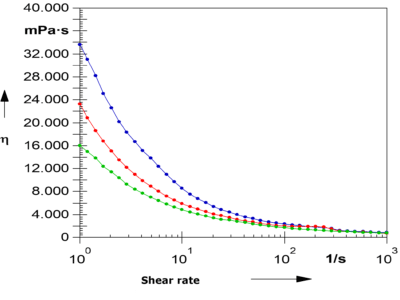
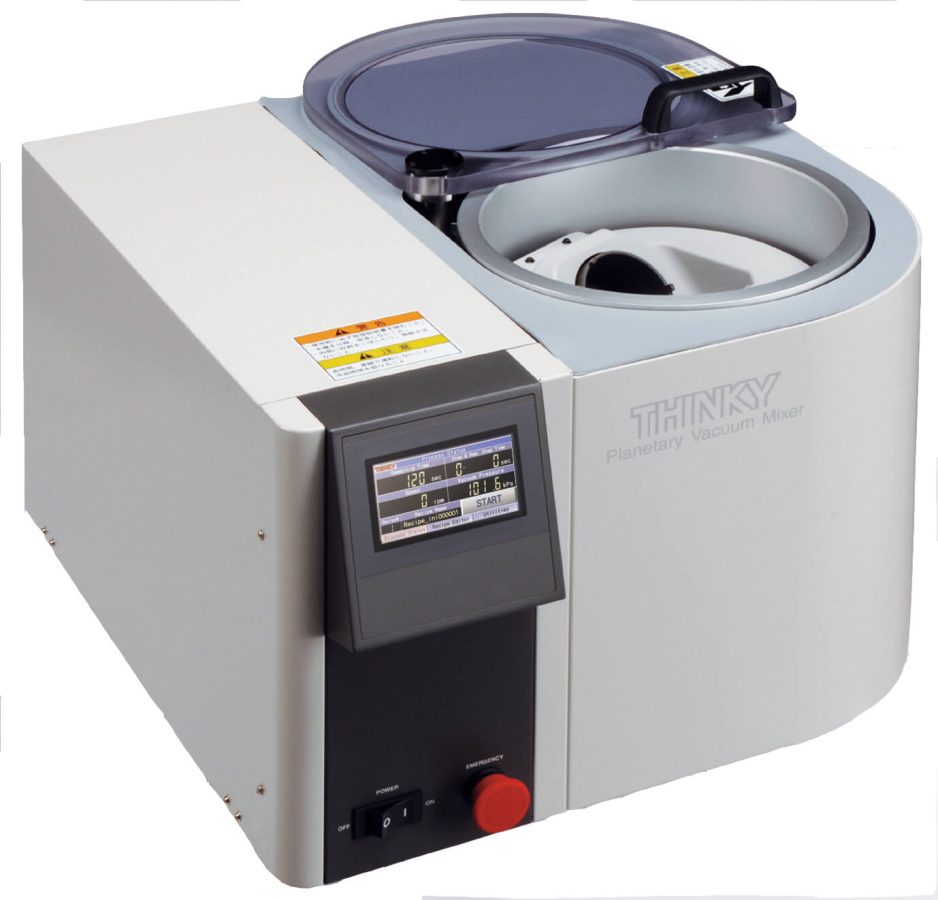
The use of the vacuum rotation/revolution mixer THINKY ARV-310 makes it possible to produce visually homogeneous NMC inks with a solid content in excess of 65% weight in a few minutes. Figure 1 shows that the viscosity decreases with increasing mixing time. Extended mixing times can produce inks of higher solids content with constant viscosity.
Results
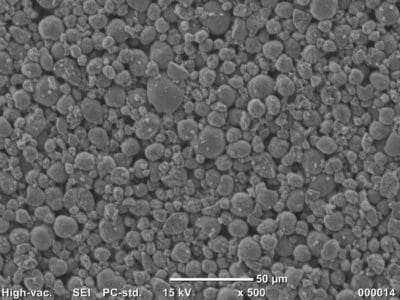
Even better results can be achieved using multi-stage mixing processes. With intermediate steps with very high solid content (>80%), and so very high viscosities, the ink experiences very high shear forces. As a result, carbon black agglomerates are completely pulverised, creating homogeneous coatings, as shown in Figure 2.
The mixing process is extremely effective; electrodes produced in this way with a high active material proportion (96%) have good adhesive properties and flexural strength. These electrodes with high area capacities (>2 mAh/cm2) were also evaluated in coin-cell batteries. In electrochemical tests, they offer high capacities at high rates (~130 mAh/g at 3 C).
Acknowledgement: The research was subsidised by the “ExZellTUM” project run by Germany’s Federal Ministry of Education and Research (BMBF), subsidy number 03X4633A.

![]() | ![]() |
|---|