Plasma pre-treatment for PTFE fabric marking

Customer benefits

  • Enables printing onto PTFE fabric
  • Surface energy increased from less than 30 mN/m to 38 – 42 mN/m
  • Easy to integrate into the printing process
  • Repeatable, controllable, traceable

Introduction

PTFE is a chemically inert material with extremely low surface energy. As a result, it is difficult for materials to wet, and almost no inks, coatings or adhesives adhere to it without some form of surface pre-treatment.

When a substrate’s surface energy is too low for a material to sufficiently wet to it, plasma can be applied to increase the surface energy to allow better wetting. It can also alter  chemical groups on the surface, creating bonding anchors for the material. Plasma microcleans surfaces and removes small contaminants that would otherwise impede bonding, printing, and coating.

A leading tool solutions company for surface finishing was looking for a way to safely and effectively mark PTFE fabrics using continuous inkjet printing. However, the material’s low surface energy made it difficult for the customer to achieve a clear, abrasion-resistant marking of a Data Matrix code.

To establish a method to reliably increase the surface energy of its PTFE fabrics, it turned to the new piezobrush® PZ3-i, in combination with a the KEYENCE MK-G1000SA continuous inkjet printer.

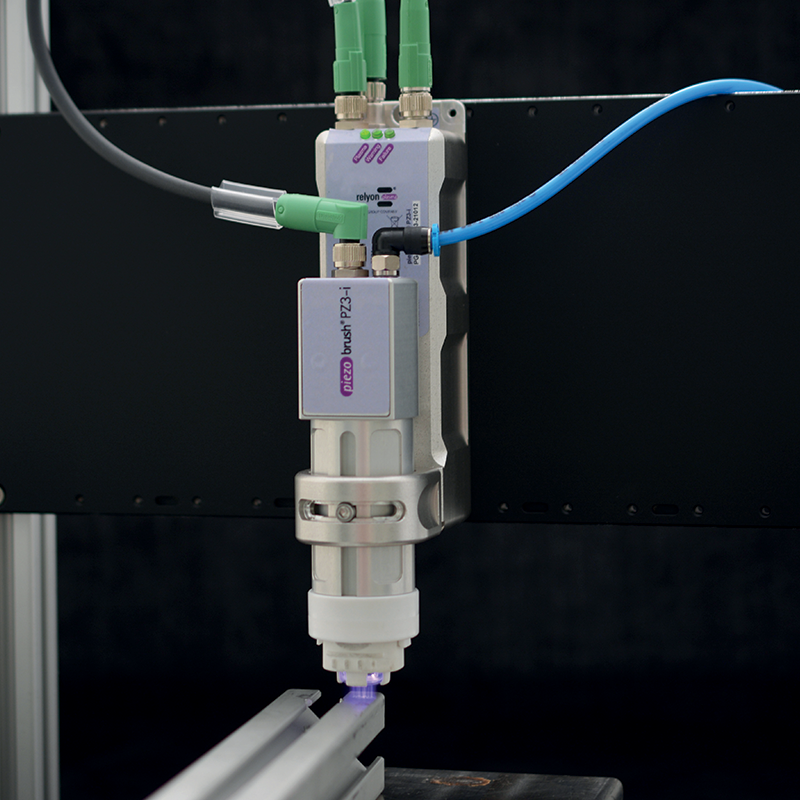
The PZ3-i is designed specifically for integration into fully or partially automated systems, and allows you to combine the effectiveness of plasma surface activation for improved adhesion, wetting, and cleanliness of substrates, with the superior productivity and repeatability of automation. The device is intuitive to operate and can be maintained without tools.  It is compact, lightweight, modular, safe, and efficient. It can be quickly and easily integrated into production lines in partially or fully automated systems, or is stand mountable for benchtop use – requiring only 24V DC power and dry compressed air.

The device uses Piezoelectric Direct Discharge (PDD®) Technology, developed by Relyon Plasma, to transform low input voltage into high electric field strengths, dissociating and ionizing the ambient gas. The plasma generated is less than 50˚C, meaning it is suitable for treating temperature sensitive substrates.


The PZ3-i in practice

Five different fabrics were tested to validate the effectiveness of plasma pre-treatment with the PZ3-i. First, the PTFE fabric was placed on a conveyor belt at a pre-defined speed. The plasma module was activated via signal input of an optical sensor, triggering treatment of the fabric.

The process speed was 35 mm/s, and the distance between substrate and piezobrush was set between 2 to 3 mm, with dry compressed air as the process gas and the inlet pressure set to 1.2 bar (corresponding to a gasflow of 10 l/min). With a plasma power of 100% and the Standard Module of the PZ3-i rotated to 45˚, the customer achieved a treatment width of 15 mm.

For all the tested fabrics, the surface energy was less than 30 mN/m without pre-treatment and between 38 – 42 mN/m after plasma treatment.

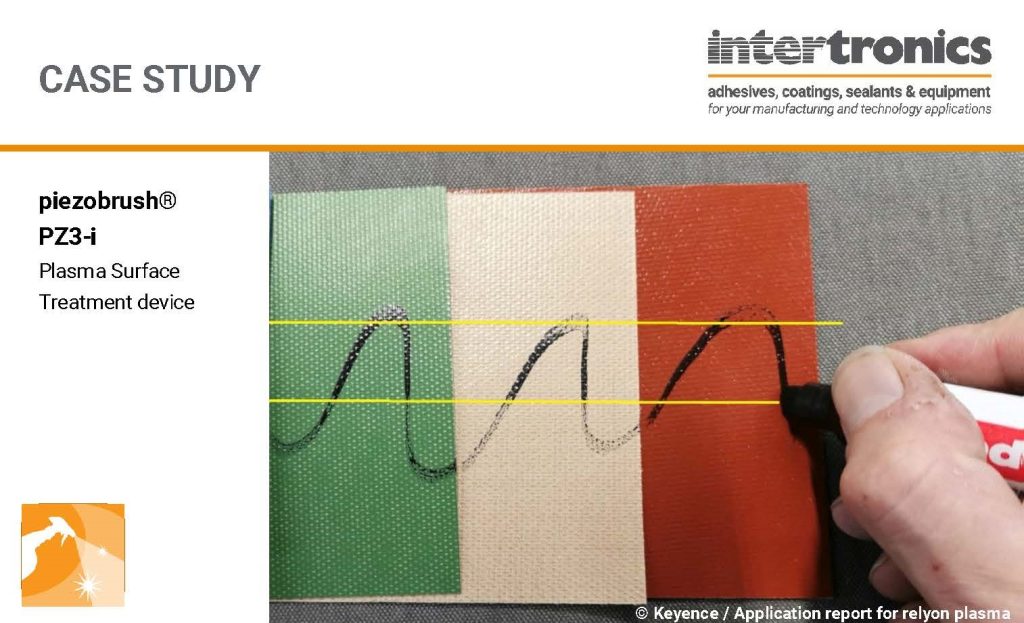
Following surface treatment, the fabric was marked with an individual, numerically ascending, 12 mm wide Data Matrix code using a KEYENCE MK-G1000SA continuous inkjet printer and KEYENCE MK-13 test ink.

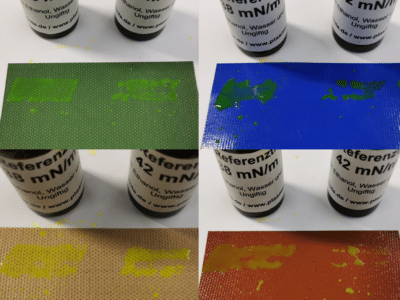
Keyence Composite image of dyne ink on PTFE fabric to show surface energy
Figure 1: On each test piece we were able to show adequate wetting using dyne inks on the treated left-hand side, the right-hand side being untreated.

Reliably marking PTFE

Plasma pre-treatment was found to be essential to reliably mark the fabric, as below a surface energy of 38 mN/m the printed image appeared faded, was not abrasion resistant, and the DMC could not be read. With plasma pre-treatment, the readability of the DMC was good, while resistance to temperature and friction was satisfactory.

The customer achieved a reliable process with good traceability, and found that the PZ3-i could easily be integrated into the process.

Ben Swanson, Chief Commercial officer at Intertronics said:

“This is a great example of where surface pre-treatment enables a bond where it would otherwise not be possible. The small-scale nature of the PZ3-i meant the customer could achieve a processing performance level that would otherwise only be possible using larger and more expensive equipment, or the use of hazardous chemicals.”

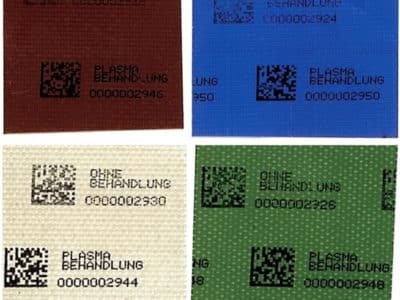
PTFE Dot Matrix Fabric Marking - PZ3-i plasma treatment
Figure 2: The upper image on each PTFE fabric sample is untreated. There is a clearer, more durable printed image on the bottom of each sample which has been treated.

Last updated: 27 March 2023

Version: 1.0

Download

Download a printable copy of this resource.