Browse industry-specific solutions for bonding, coating, and dispensing. Find proven materials and manufacturing technology tailored to your exact requirements.
The endless piston pump technology for precision dispensing
Introduction
Accurate, consistent dispensing of industrial fluids and liquids is prerequisite in fields such as medical device manufacturing (to ensure validated repeatability) or microelectronics (to ensure precision).
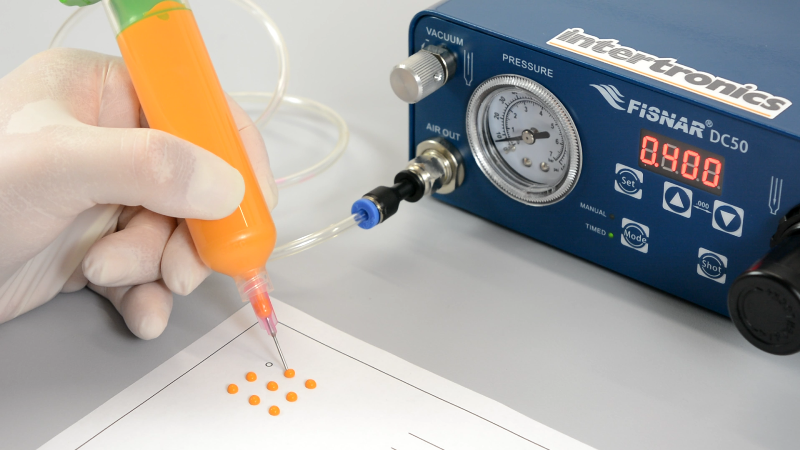
Ubiquitous time/pressure systems – in common usage for the last 30 years – are perfect for many general applications where such precision is not required and a more sophisticated approach would represent over-specification.
Figure 1 – A time/pressure dispensing controller with digital timer
Factors limiting the ability of this technology to dispense with the accuracy and repeatability required for some high precision applications, include air inclusion in the barrel during packing which will affect deposit accuracy, and material viscosity variations owing to changing ambient temperature, repeated quick air pulses or because of curing.
Another issue is the variability in dispensed quantity as the syringe barrel empties. The amount of compressible air in the system increases accordingly, which means that the pulse of compressed air from the dispensing controller has a lesser, delayed impact on the liquid. Some of these limitations can be mitigated by the use of dispensing valves1.
Endless Piston Principle®
The quest for a true, volumetric dispense has led to the development of valves which work on a ‘positive displacement’ principle. Recently, a pump technology which delivers positive displacement, volumetric dispensing or dosing has been applied to the precision application of industrial materials, and which can deliver as little as 0.1 µl.
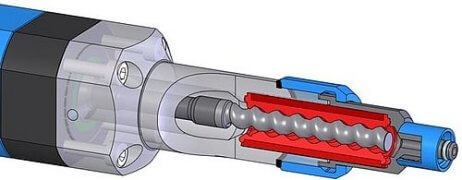
This progressive cavity pump typically consists of a single-helix metal rotor and a double-helix hole in an elastomeric stator. The rotor seals against the stator, forming a series of pockets which translate along as the rotor rotates, keeping their form and volume. The pumped material is moved inside the pockets, which are shaped so that they taper and overlap; the output is continuous, even and non-pulsing.
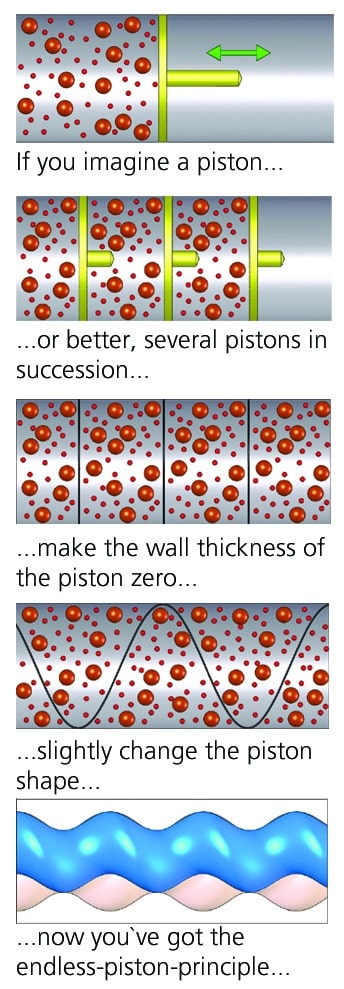
The Endless-Piston-Principle2 illustrated:
Figure 3 – The Endless-Piston-Principle
The flow rate is directly proportional to the rate of rotation and the volumetric output of the pump is directly proportional to the number of rotations. Due to the rotor/stator seal, input pressure has no effect on the pump, so it achieves true positive displacement. It is also able to pump at very low rates, and low levels of shear are applied to the pumped fluid.
Precision dispensing
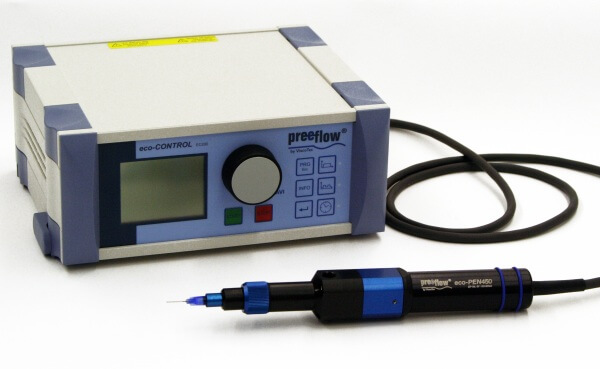
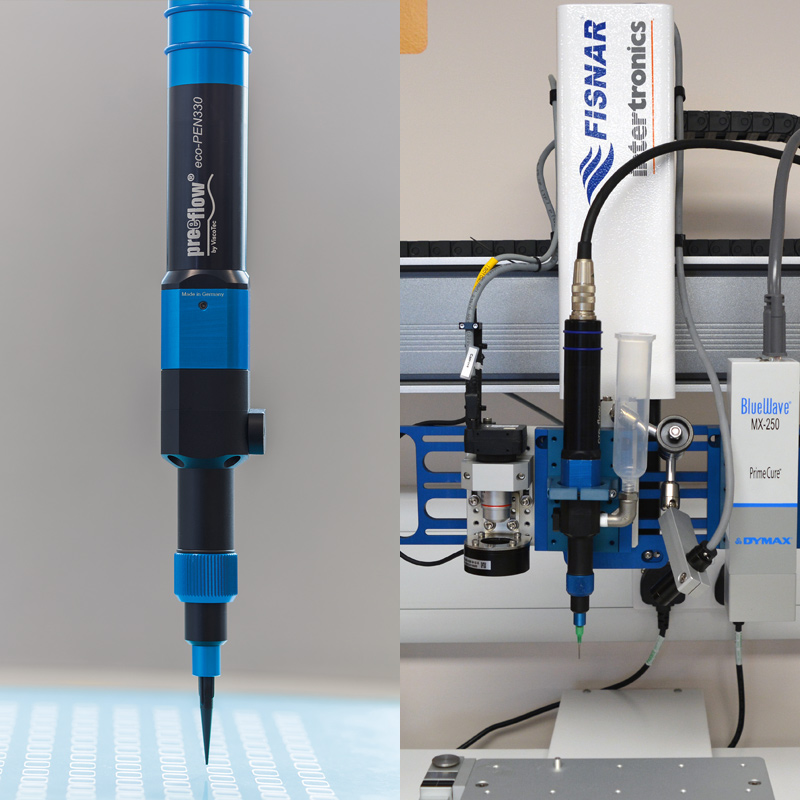
Commercially available units are available for precision applications. They consist of the rotor/stator assembly and a motor drive unit, in a pen-like configuration. A separate controller allows programming of speed and number of rotations to effect dots or deposits of specific volumes, or continuous beads. Post-dispense, the motor can be reversed briefly to prevent stringing or dripping. A dispensing needle is fitted to the end of the pen using a standard luer fitting. Crucially, once a material has been characterised, a desired volume can be selected on the controller and it can be dispensed regardless of material viscosity changes and independent of ambient temperature. The technology handles viscosities from water up to thick pastes, including abrasive, filled or shear-sensitive media. Flow rates range from ~ 0.1 to 60 ml/minute. The pen can be hand-held or fitted to automation.
Figure 4 – The rotor/stator assembly in a pen configuration
Application
Dosing or dispensing is precise and process-stable, and the dispensed media remains undamaged. Control is linearly proportional, so is simple to program – and very repeatable and consistent. With automated handling, the highest precision of at least ± 1% and reproducibility over 99% of the medium is achieved. Dispensing a bead is accomplished by setting one parameter, the volume flow. Matched to the speed of a robot or other automation, it is possible to dose coherent beads down to a width of 250 µm and at traverse speeds of up to 300 mm/s.
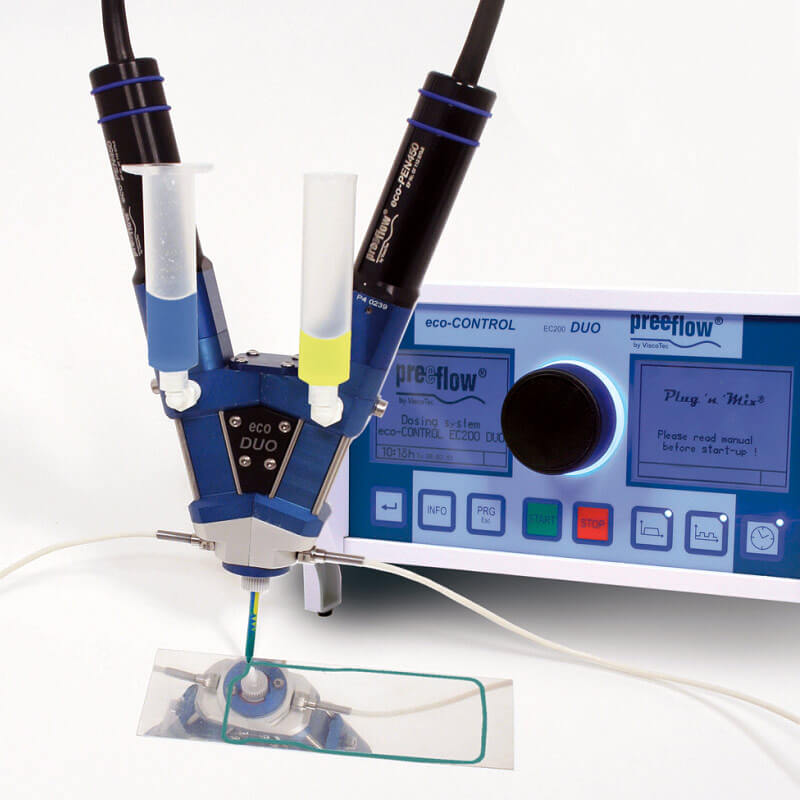
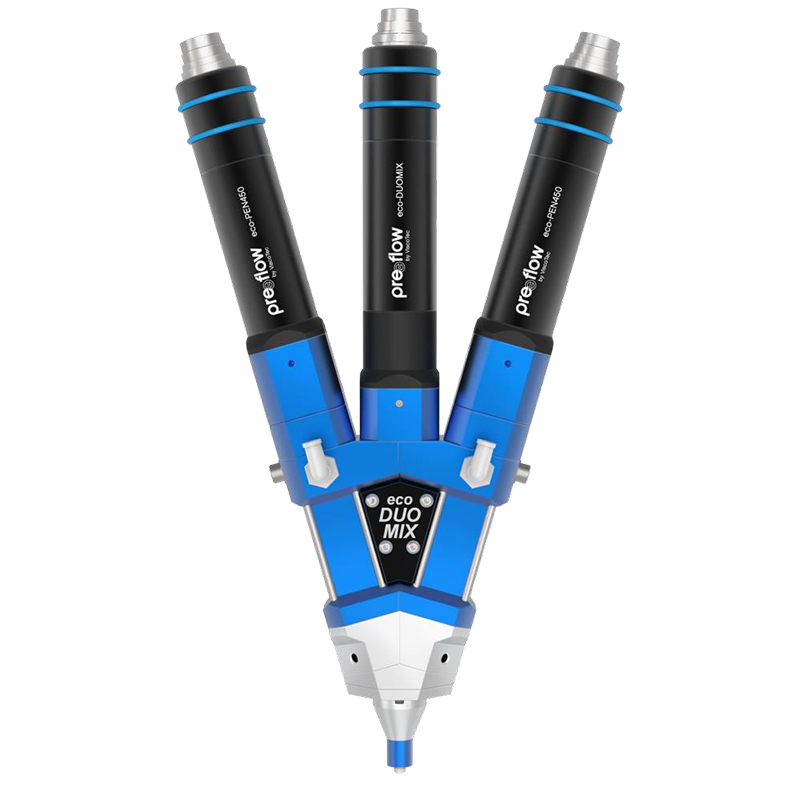
For metering and mixing, two pumps are used to supply the components to a static mixing nozzle in the correct volumetric ratio.
Figure 5 – Endless piston pump technology in a pen, with digital controller
References
“Improving Industrial Dispensing with Pneumatic Dispensing Valves”, Peter Swanson, FAST Magazine – July 2007