UV curing can deliver fast, controlled and repeatable bonding, coating and encapsulation processes. But where should an engineer begin? An enclosed benchtop UV curing chamber provides a straightforward way to develop the process, understand the important variables and manage UV exposure safely.
“If you want to get into UV curing, this is the place you start,” says Simon Gibbs, one of our subject matter experts on UV light curing. Simon has been involved in UV curing for about 25 years – he should know.
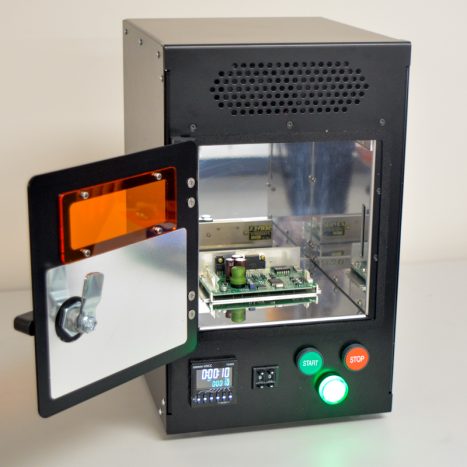 He is talking about the IUV301 LED UV Curing Chamber, a compact benchtop UV curing oven which provides you a straightforward way to develop, prove and run a controlled UV curing process.
UV curing itself is remarkably simple. Expose the right UV curable material to light of an appropriate wavelength and intensity for sufficient time, and curing can take place, usually in seconds. Developing a reliable manufacturing process around it can require rather more thought. The curing lamp needs to suit the chemistry. The component must receive sufficient and consistent UV exposure. Part geometry, distance from the light source and shadowed areas may need consideration. And the variables which affect the cure need to be understood and controlled if the process is going to be repeatable. That can make UV curing appear more complicated to somebody encountering it for the first time than it really needs to be.
So, put the UV curing process in a box
An enclosed benchtop chamber removes many of the practical variables which can otherwise complicate getting started. With the IUV301, components are placed inside a reflective curing chamber, the UV intensity and exposure time are set, and the door is closed before curing begins. Rather than designing a curing arrangement around an open UV source, you have a defined environment in which to establish and repeat the process.
The IUV301 LED UV Curing Chamber is available with 365 nm, 385 nm or 405 nm UV LED wavelengths. This is important: the UV source should be selected to suit the chemistry, because you can’t make the chemistry work with whatever UV lamp happens to be available. Successful UV curing depends on matching the spectral output of the lamp with the absorption characteristics of the photoinitiator system in the material.
UV LED technology also provides instant on/off operation without a warm-up period. The output can be adjusted and the exposure time controlled, giving you straightforward parameters with which to develop the curing process. The reflective chamber is designed to provide good UV exposure, including from multiple directions – good with three-dimensional components where UV needs to reach more than one surface.
A straightforward way to develop a UV curing process
This makes the IUV301 particularly useful during process development. If you are evaluating a UV curing adhesive, coating or encapsulant, you can start to understand and establish suitable curing conditions without first having to design a production UV curing installation. Different settings can be evaluated and, once satisfactory curing conditions have been established, they can be documented and repeated. This is an important distinction. Getting started with UV curing isn’t simply a matter of buying a UV lamp. The objective is to establish a UV curing process which produces the required result consistently. The chamber provides a controlled environment in which to start doing that.
 Controlling the UV which doesn’t reach the component
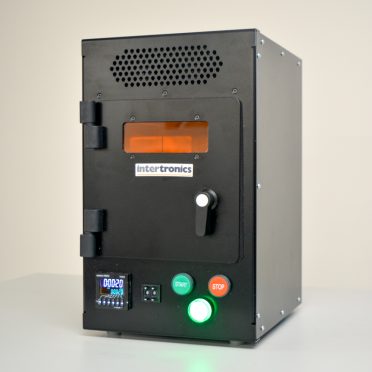
There is another important reason for starting with an enclosed curing chamber: safety. UV curing equipment produces potentially hazardous radiation. With an open UV spot or flood lamp, shielding, reflections, access to the curing area, appropriate operating procedures and personal protective equipment may all need to be considered as part of the workstation design. An enclosed chamber approaches the problem differently. The LED UV source is contained within the IUV301. Components are loaded into the chamber and the door is closed before exposure begins, with a safety interlock preventing operation while the door is open. Good engineering practice is to control a hazard through the design of the equipment, if you can.
So the chamber provides control in two directions: control over the UV light reaching the component, and control over the UV light which could otherwise reach the operator. For a laboratory or production team introducing UV curing for the first time, that makes an enclosed chamber a particularly straightforward starting point.
Starting point doesn’t mean beginners’ equipment
Calling the IUV301 a good place to start shouldn’t suggest that its usefulness ends once a UV curing process has been developed. For many applications, the chamber can remain the production solution. Its benchtop format makes it suitable for R&D and process development, but also for low-volume manufacture, batch processing, quality control and production applications where components can conveniently be loaded into a chamber for curing. For higher-volume processes, what is learned in the chamber can help inform the next stage. Depending on the component and production requirements, that might ultimately mean moving to a dedicated UV LED spot lamp, flood curing system, conveyor or automated curing process. In other applications, there may be no reason to move at all. If the chamber provides the required cure, throughput and process control, the simplest solution may also be the production solution.
Start with the process
UV curing can offer you some compelling advantages: curing in seconds, on-demand processing and the ability to develop highly repeatable bonding, coating and encapsulation processes. But the place to start isn’t simply with a powerful UV lamp. Start by choosing a UV source which suits the chemistry. Understand the variables which determine the cure. Control the exposure received by the component. Consider operator safety from the outset. Then establish curing conditions which can be repeated reliably. Putting all of that inside an enclosed benchtop chamber makes the first steps considerably easier.
Which brings us back to Simon: “If you want to get into UV curing, this is the place you start.”
Come and see an IUV301 LED UV Curing Chamber in our Technology Centre. And talk to us about UV adhesives, encapsulants and other UV curable materials.
