Browse industry-specific solutions for bonding, coating, and dispensing. Find proven materials and manufacturing technology tailored to your exact requirements.
How progressive cavity pump technology enables validated, repeatable material dispensing in medical device, electronics, and other high-reliability manufacturing sectors
Introduction
The Holy Grail of material dispensing is simple to describe but not always easy to achieve: applying an exact specified volume, every time. In medical device manufacturing (and other high-reliability industries such as electronics, automotive, aerospace, optics, life sciences), where validation depends on eliminating or controlling variables1, the ability to apply the same volume precisely and repeatably is fundamental. Whether dispensing an adhesive, coating, ink, solder paste, flux, enzyme, or catalyst, even the smallest deviation in quantity can affect bond strength, coating uniformity, or device performance – and ultimately, process reliability.
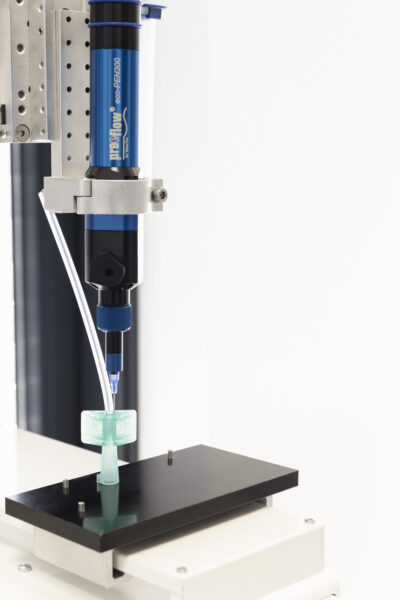
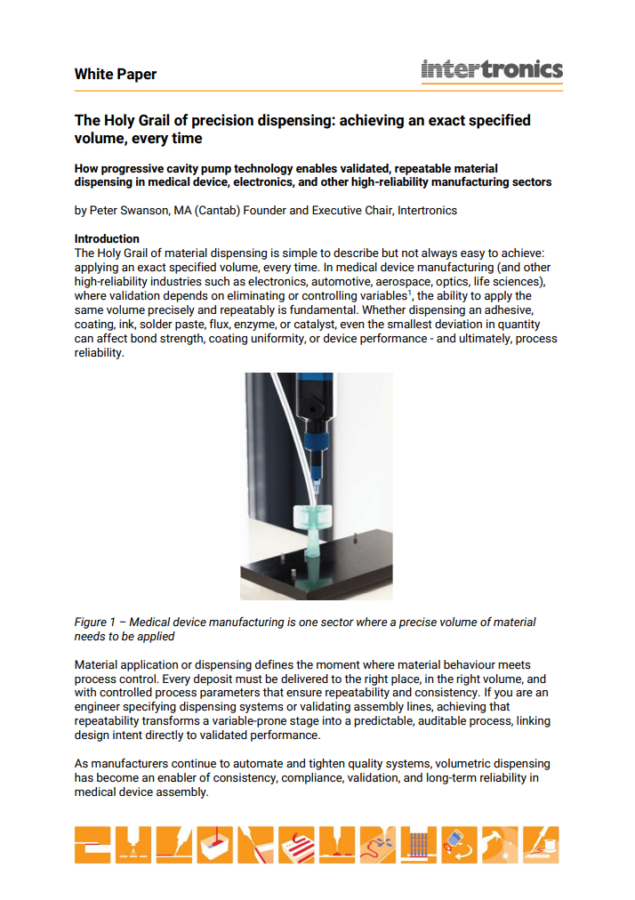
Figure 1 – Medical device manufacturing is one sector where a precise volume of material needs to be applied
Material application or dispensing defines the moment where material behaviour meets process control. Every deposit must be delivered to the right place, in the right volume, and with controlled process parameters that ensure repeatability and consistency. If you are an engineer specifying dispensing systems or validating assembly lines, achieving that repeatability transforms a variable-prone stage into a predictable, auditable process, linking design intent directly to validated performance.
As manufacturers continue to automate and tighten quality systems, volumetric dispensing has become an enabler of consistency, compliance, validation, and long-term reliability in medical device assembly.
Time/pressure dispensing
For over 40 years, the dispensing of industrial fluids has been improved by simple time-pressure dispensing machines (also called dispensing controllers). A syringe‐like barrel with the liquid inside is attached to the dispensing controller, which upon demand, pushes compressed air into the larger end. This compressed air can be a timed pulse. The air pushes the liquid out of the smaller end of the syringe barrel, usually through a dispensing needle or nozzle. The amount dispensed is dependent on the:
Rheology of the liquid (viscosity, thixotropy, etc)
air pressure
time of the pulse of air
size of the orifice in the needle
The latter three factors are selectable, and with the choice of a suitable combination of these, most flowable liquids can be dispensed in beads or drops with a reasonable amount of accuracy and repeatability. Many thousands of these machines have been sold, with major benefits to users, including material control and health & safety.
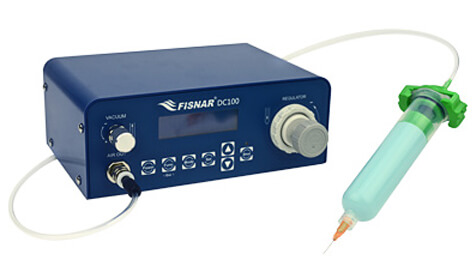
Figure 2 – A time-pressure dispensing controller with a digital timer
Typically, these devices are used manually or in a semi‐automated process. With low viscosity liquids, and the finest needle size (industrial dispensing needles are available down to 50 µm ID at the dispensing end), quite small dots can be applied.
Limitations of this approach include having to have the liquid packed in a dispensing syringe barrel; many materials are available from manufacturers packaged appropriately, or they can be filled subsequently by a third-party service or in‐house. Any air inclusion in the barrel will affect deposit accuracy, so the filling process (which may include centrifuging) is a factor.
One variable which is difficult to control is material viscosity; the less viscous the fluid is, the greater its ease of movement, and the larger the dispensed amount will be for the same settings. Viscosity can change with ambient temperature, or with repeated short air pulses. The material may also change due to curing e.g. a mixed epoxy adhesive.
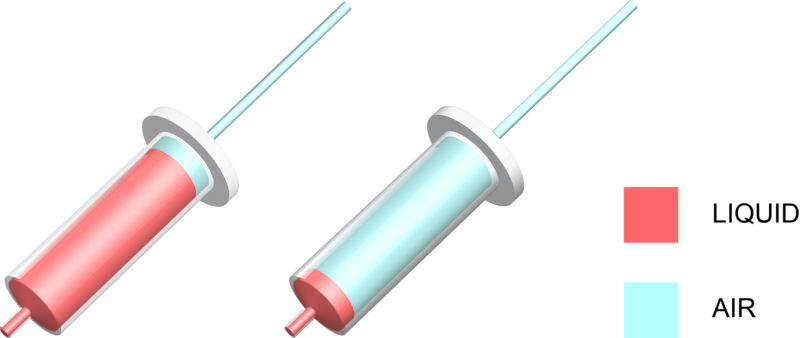
Another issue is the variability in dispensed quantity as the syringe barrel empties. The amount of compressible air in the system increases accordingly, which means that the same pulse of compressed air from the dispensing controller has a lesser, delayed impact on the liquid, resulting in smaller deposits.
Figure 3 – As the barrel empties, volume of air in the system increases, causing variations
Some of the limitations of simple time/pressure dispensing can be mitigated by the use of dispensing valves. These are typically pneumatically controlled valves into which the material is fed (usually under pressure from a reservoir) and which allow the material flow to be started/stopped or otherwise controlled. A previous article gives more detail2.A fully automated fluid application operation often uses a dispensing valve, as it precludes the need for the exchange of empty barrels for filled ones, for example.
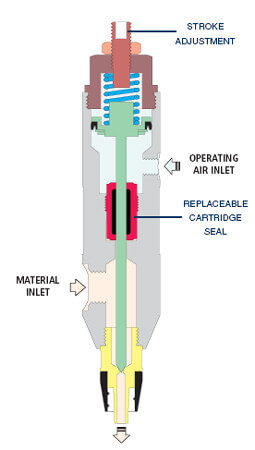
Figure 4 – A schematic of a pneumatic dispensing valve showing operating principle
Positive displacement
For processes where variability in volume applied must be highly controlled, or indeed eliminated, the next step beyond pneumatic control is positive displacement. The quest for a true, volumetric dispense has led to the development of valves which work on a “positive displacement” principle. Within the valve, a cavity of the desired volume is filled with the liquid, and then this volume is ejected – mechanically or pneumatically. For example, this can be achieved with a tube which is pinched by pistons at either end to form a cylinder of the appropriate volume. The sequence of opening and closing the pistons will dispense that volume. Another method is to use an auger screw inside a tube which can be driven by a motor. These valves are usually specific to a limited range of deposit size or to certain viscosities and may have other limitations.
Progressive cavity pump
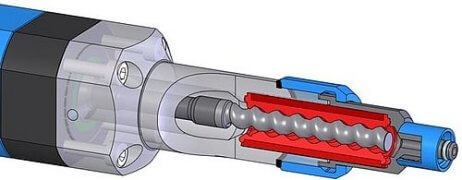
A progressive cavity pump is a type of positive displacement pump. Typically, it consists of a single‐helix metal rotor and a double‐helix hole in an elastomeric stator. The rotor seals against the stator, forming a series of spaces or pockets, which translate along as the rotor rotates, keeping their form and volume. The pumped material is moved inside the pockets. In addition, the pockets are shaped such that they taper and overlap; the output is continuous, even and non‐pulsing.
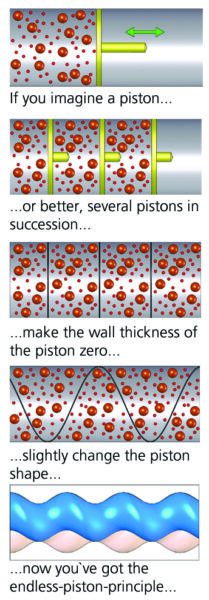
Another way to envisage this is the concept of the endless piston principle.
Figure 5 – The Endless-Piston-Principle
The flow rate is directly proportional to the rate of rotation (which can be reversed), and the volumetric output of the pump is directly proportional to the number of rotations. Due to the rotor/stator seal, input pressure has no effect on the pump, so it achieves true positive displacement. It is also able to pump at very low rates, and low levels of shear are applied to the pumped fluid.
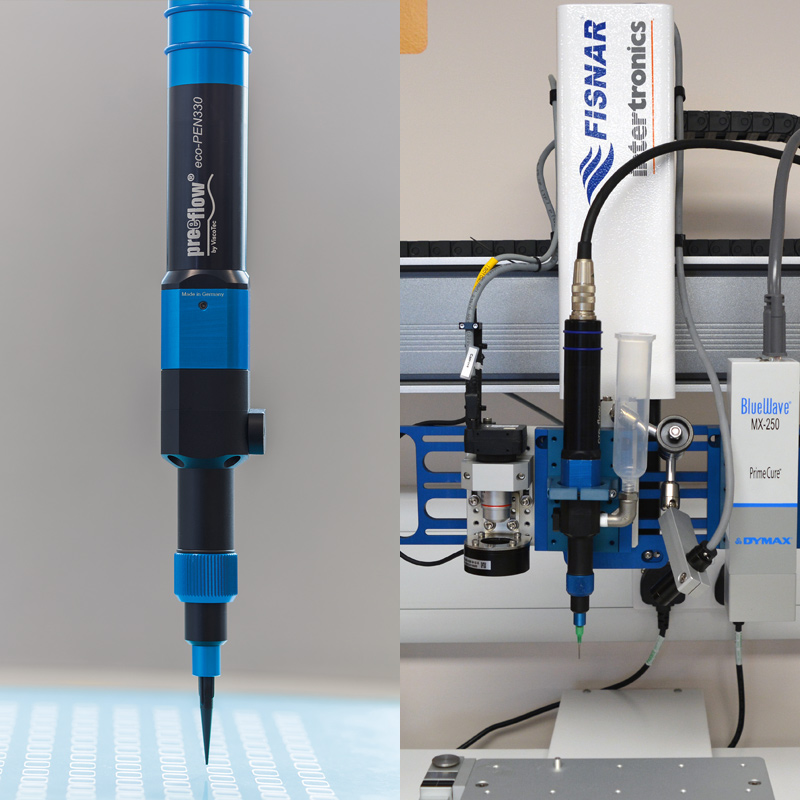
Dispensing or dosing units based on this technology are available for precision applications. They consist of the rotor/stator assembly and a motor drive unit, in a pen‐like configuration. A separate controller allows programming of the motor – speed and number of rotations to effect dots or deposits of specific volumes, or continuous beads. At the conclusion of a dispense, the motor can be reversed briefly to prevent stringing or dripping. A dispensing needle is fitted to the end of the pen using a standard luer fitting. Crucially, once a material has been characterised, a desired volume can be selected on the controller, which is dispensed regardless of material viscosity changes and independent of ambient temperature. The technology handles viscosities from water up to very high viscosity pastes, including abrasive, filled or shear‐sensitive media. Flow rates range from ~ 0.004 to 60 mL/minute. The pen can be hand‐held or fitted to automation.
Figure 6 – The rotor/stator assembly in a pen configuration
Applications
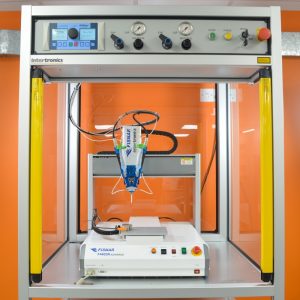
The benefits of the continuous, volumetric positive displacement pump include precise, process stable dosing or dispensing, which is benign to the media. Control is linearly proportional, so is simple to program – and very repeatable and consistent. Dispensed quantities can be as low as 0.25 μL. With automated handling, the highest precision of at least ± 1% and reproducibility over 99% of the medium is achieved. Dispensing a bead is accomplished by setting one parameter ‐ the volume flow; matched to the speed of a robot or other automation, it is possible to dose coherent beads down to a width of 100 µm and at traverse speeds of up to 300 mm/s.
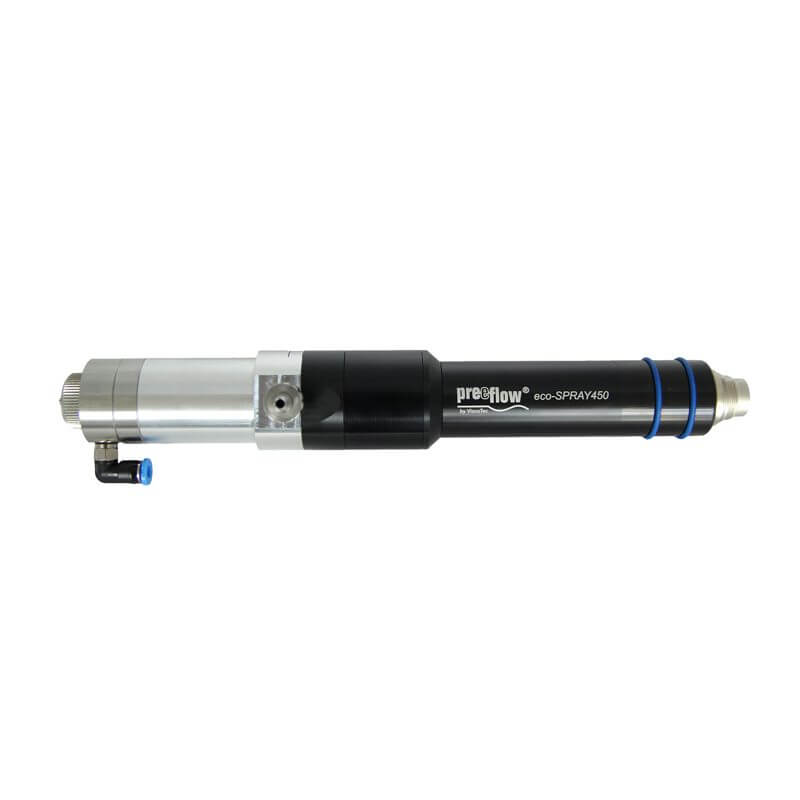
Figure 7 – A progressive cavity pump in a format suitable for integrating into a production process
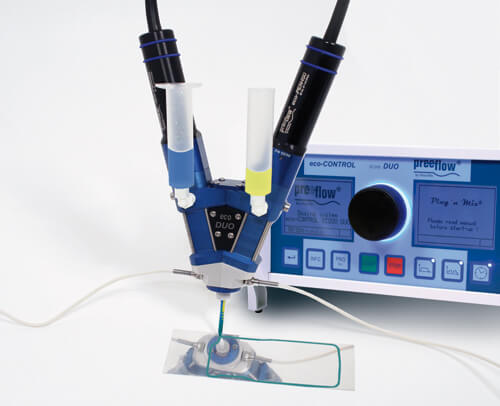
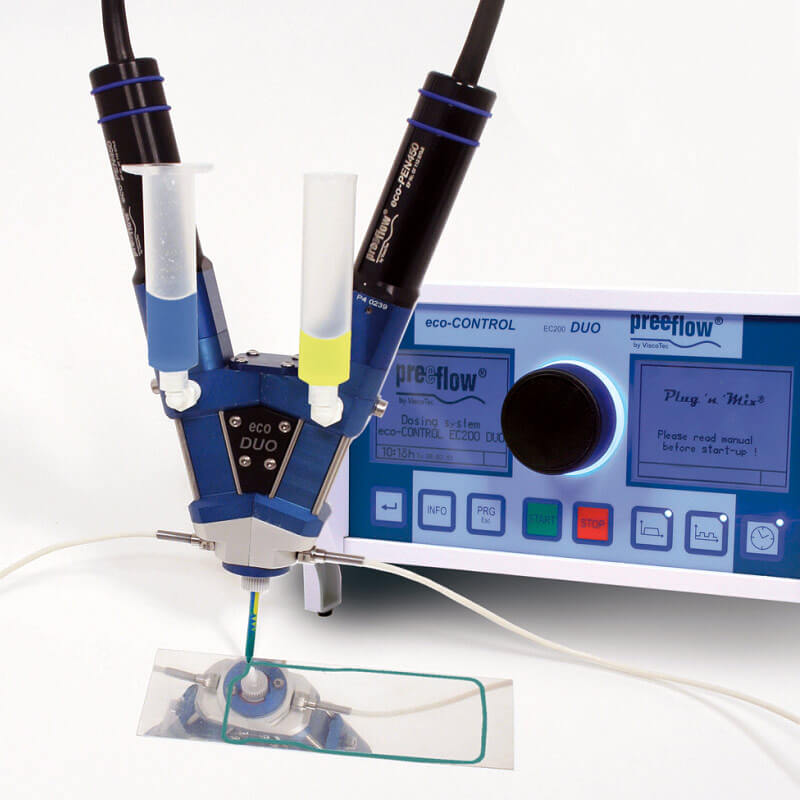
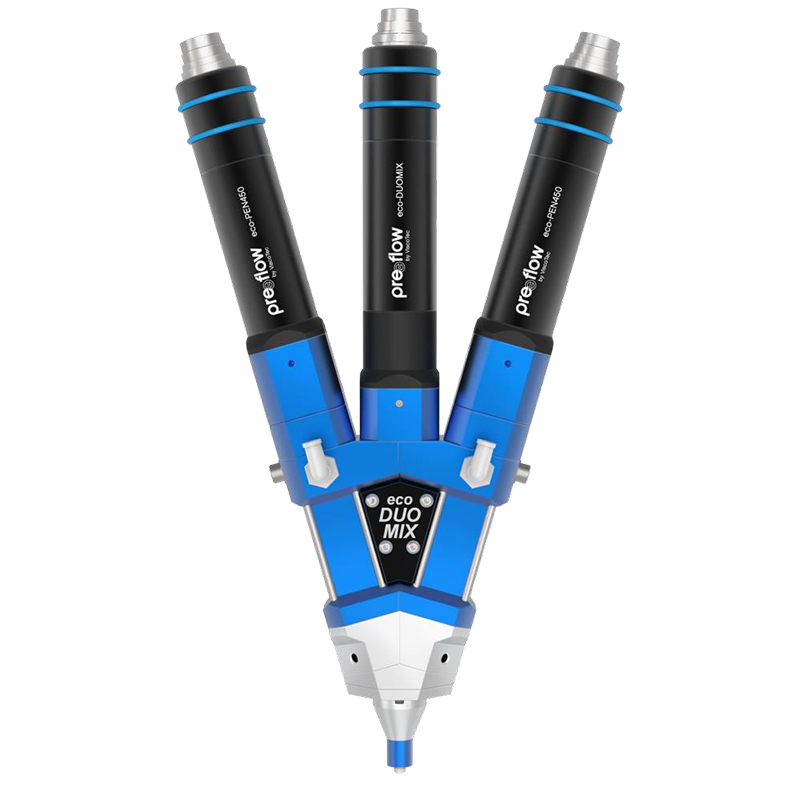
The same technology has been applied to metering and mixing two component materials3; two pumps supply the components to a static mixing nozzle in the correct volumetric ratio.
Figure 8 – Progressive cavity pump technology can be used to meter, mix and dispense two component media
It has found applications in optics and photonics, biochemistry, photovoltaics, electronics and semiconductor manufacturing and, of course, medical device manufacturing.
Summary
Volumetric, positive-displacement dispensing technology turns a variable-prone step into a quantifiable process. By applying a defined volume under controlled parameters, it removes a stubborn source of variation in material application. For manufacturers in MedTech and other high-reliability sectors, that control strengthens process validation, reduces rework and risk, and builds long-term confidence in quality and compliance. Precision dispensing isn’t just about accuracy — it’s about transforming material application into a validated, repeatable, and reportable process.