Browse industry-specific solutions for bonding, coating, and dispensing. Find proven materials and manufacturing technology tailored to your exact requirements.
Growing demand for lithium-ion batteries has inspired businesses to develop electrode slurry materials and optimise existing formulations. Electrode slurry consists of electrode particles, small carbon particles to help conduction, and binder material (polymer and solvent) to hold the structure together. With these particles often representing between 20-40% of the total by weight, getting a consistent, even mix and dispersion is highly important for battery efficiency.
Battery slurry is typically not suitable for traditional mixing (with blades, impellers, paddles, spatulas, etc), for a number of reasons. Contact mixing typically results in operator variance, difficulty validating the process, poor dispersion, or a high defect rate. Due to the high viscosity and heavy filler content of battery slurry, it can be difficult to achieve a homogenous mix, or result in RSI for operators after long periods of mixing. Finally, contact mixing has a tendency to introduce too much air to the mixture.
Planetary centrifugal mixers
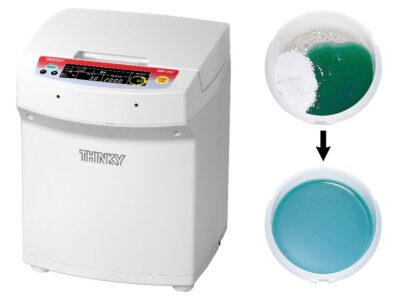
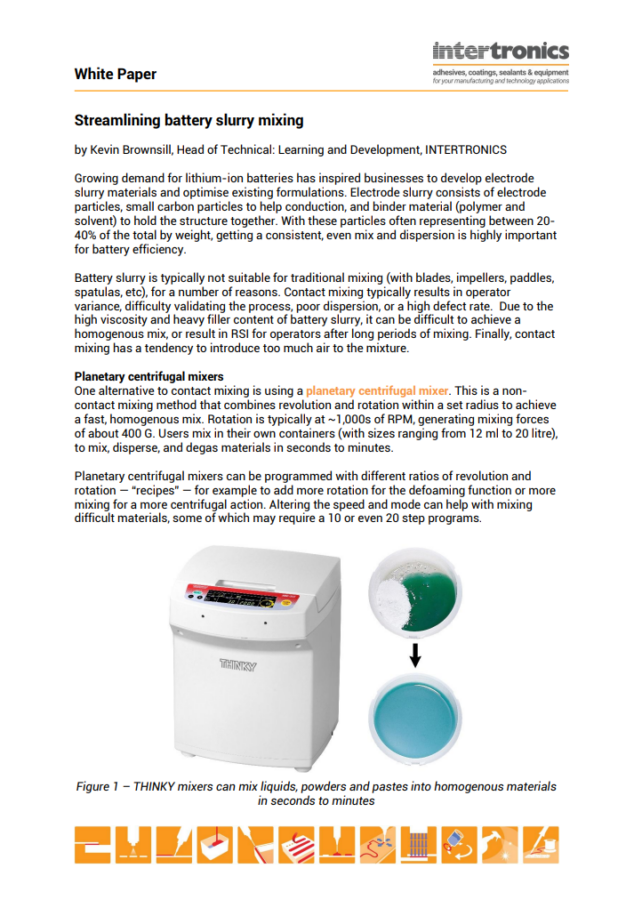
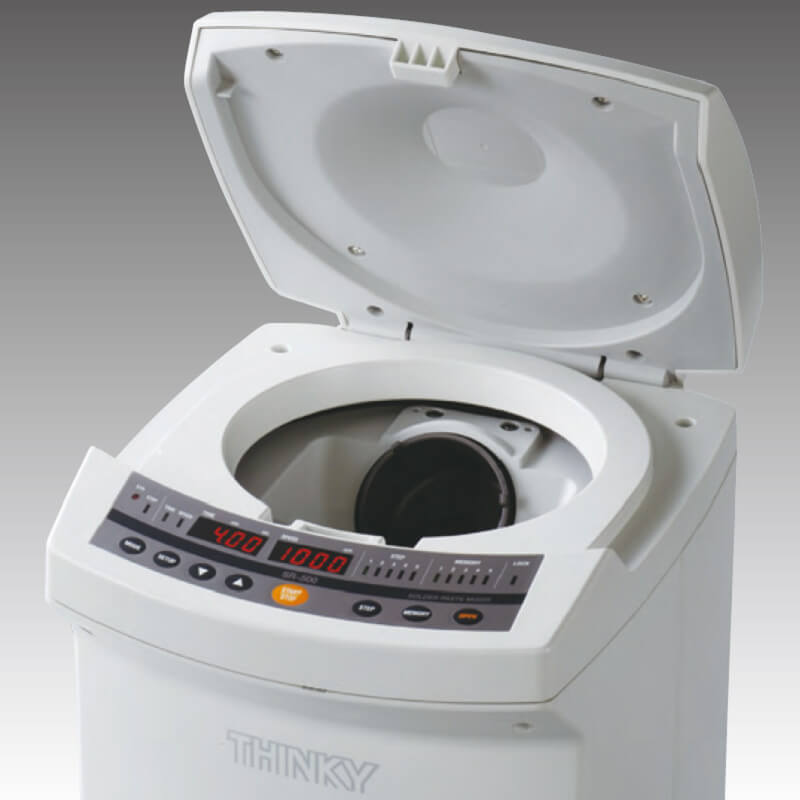
One alternative to contact mixing is using a planetary centrifugal mixer. This is a non-contact mixing method that combines revolution and rotation within a set radius to achieve a fast, homogenous mix. Rotation is typically at ~1,000s of RPM, generating mixing forces of about 400 G. Users mix in their own containers (with sizes ranging from 12 ml to 20 litre), to mix, disperse, and degas materials in seconds to minutes.
Planetary centrifugal mixers can be programmed with different ratios of revolution and rotation — “recipes” — for example to add more rotation for the defoaming function or more mixing for a more centrifugal action. Altering the speed and mode can help with mixing difficult materials, some of which may require a 10 or even 20 step programs.
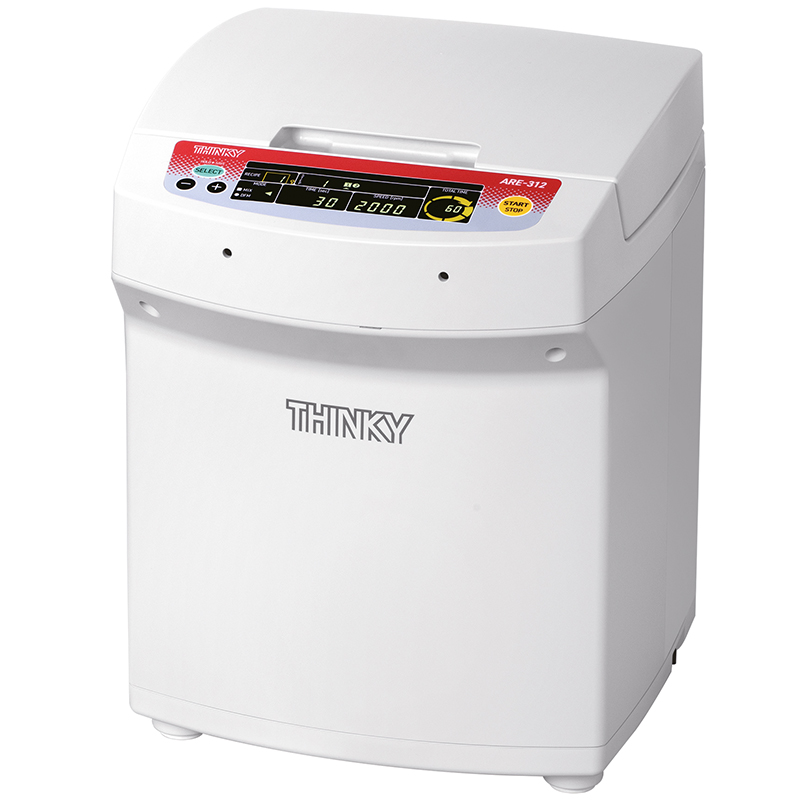
Figure 1 – THINKY mixers can mix liquids, powders and pastes into homogenous materials in seconds to minutes
The benefits of non-contact mixing
With a planetary centrifugal device, mixing takes place in removeable containers, meaning the cleaning process is straightforward. This saves time, avoids cross contamination, and makes it easier for the technology to be repurposed for other applications.
Adopting a planetary centrifugal mixer can remove steps from a process compared with manual contact mixing processes, saving time and reducing labour costs. Material can be simultaneously mixed, dispersed, and degassed with minimal operator intervention, freeing up team members for more valuable work elsewhere. The technology can reduce process waste by reducing the risk of contamination, while the removed need for decanting reduces waste left in containers. The ability to repeat the process can reduce variation due to operator skill and improve product formulation.
Planetary centrifugal mixing is effective at controlling shear, and is usually quite benign to the products. Additionally, unlike machines that rely on the insertion of paddles or impellers into the material, no air is introduced; in fact, there is a tendency to remove it.
Process traceability
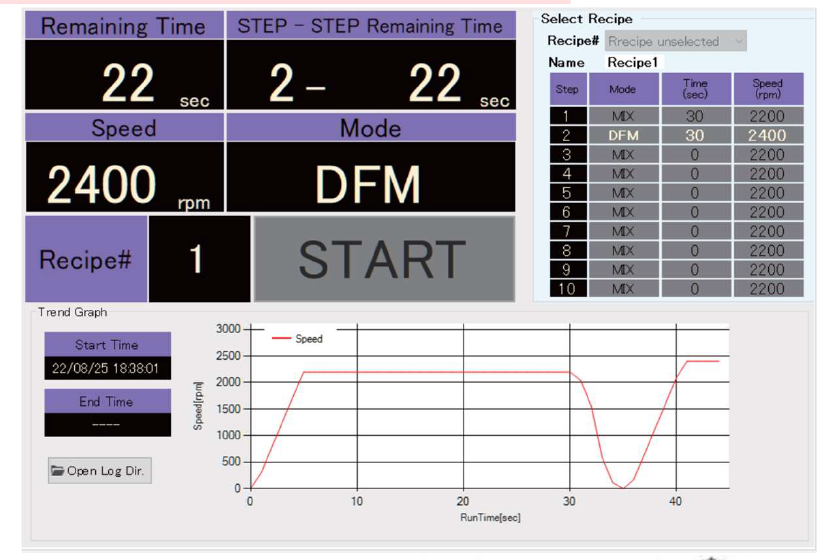
Planetary centrifugal mixers enable precise and repeatable control of the mixing process; process variables are programmable. Some models offer data logging and PC connectivity, giving operators information on RPM, mode, and which recipe is being used. Mixers with communication functions can provide remote control and traceability functions — the user can start/stop operation and report abnormal stop information.
Manufacturers can collect data from their mixer to see the exact RPM in near real-time and validate that the correct program was used for a particular batch — useful for quality assurance and as a development tool.
Figure 2 – THINKY ARE-312 mixer process data being recorded by remote software
Selecting a mixer
There are various planetary centrifugal mixers available, some that purely mix, some that mix and degas, and some that degas to a high level under vacuum. Machine selection is normally based on two considerations, batch size and the required level of air removal.
While many manufacturers opt for a larger mixer for higher volume applications, others operate multiple smaller machines to avoid a large upfront investment, prevent a single point of failure, and increase flexibility.
Some manufacturers may need to guarantee that all air is removed from a particular mixture. In this case, manufacturers can select a machine that mixes under vacuum, which can remove invisible micro bubbles.
Examples from the field
Due to the increased demand for mobile, rechargeable batteries with ever higher energy and power densities, intensive research is being conducted into modifying electrode structures to increase the active mass loading.
One possible approach is a three-dimensional structuring of electrodes using a cellular structure (e.g., a metal foam), which acts as a current collector. Due to the cellular structure, an electrically conductive structure is present within the active mass. This can increase the electrical conductivity of the electrode, while increasing the integrity of the active mass layer. This should make it possible to increase the electrode thickness while reducing the amount of inactive components.
In the production of foam electrodes with the highest possible active mass loading, the infiltration of the cellular structure with an electrode slurry is a decisive process step. The degree of infiltration depends to a large extent on the viscosity of the electrode slurry. In order to determine the optimum slurry composition for a given solids composition (e.g. 84 wt.% NMC, 8 wt.% conductive carbon black + graphite, 8 wt.% binder), three different cathode slurries with different solids contents were prepared using the Thinky ARM-310 planetary centrifugal mixer via a multi-stage process.
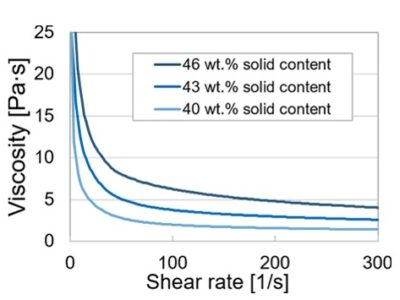
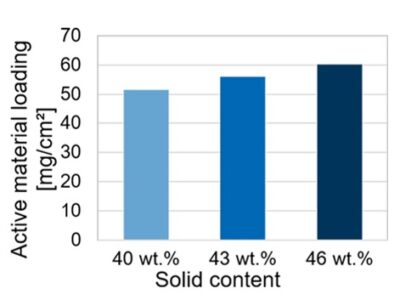
The viscosity curve of the three slurries in figure 3 shows that the viscosity increases with increasing solids content. Figure 4 shows the active mass loading of 1000 µm thick NiCr foam rounds (Ø 10 mm, 450 µm cell size) after infiltration and drying with the different slurries. With increasing solids content, the active mass loading increases. With further increase of the solid content in the slurry, an inhomogeneous infiltration of the slurry is to be expected due to the increasing viscosity. With the Thinky ARM-310 planetary centrifugal mixer, various slurries with different compositions could thus be produced in a very short time and a suitable composition was identified.
Figure 3 – Viscosity of different NMC cathode slurries with a solid content composition of 84-8-8 (wt.%, NMC, conductive binder) and various solid contentsFigure 4 – Active mass loading of 1000 µm thick NiCr foams (10mm) after infiltration with slurries containing different solid contents
Another example comes from Ed Harrison during his time at the University of Birmingham as a student. As part of an eight-week placement, he produced a poster on Making and Testing Cathode Materials – Preparation and characterization of advanced coatings on cathode materials.
Harrison said: “The primary step to making a cathode coating is to mix all the required components. First the active material (NMC/LFP) and carbon black are mixed using a THINKY Mixer at 1,300 RMP, to make them as homogenous as possible before any solutions are added. Then binder is added, for which I used 8% PVDF in NMP. The last step of the mixing process involves adding the solvent, for example, NMP. This is to decrease the solid content of the slurry, ensuring all powders are dissolved, and to reach a suitable viscosity to be used when coating.”
A good supplier can address your challenge by doing laboratory evaluations and demonstrations with your materials. Based on previous experience, it can advise on the best mixer for your process.
Picture credits
Figures 1, 2 – Intertronics
Figures 3, 4 – M.Sc. Jonas Oehm & Prof. Dr.-Ing. V. Knoblauch, Aalen University of Applied Sciences, Institute for Materials Research, Germany. Website.